A 'cold blob' in the Atlantic could be a sign of AMOC shutdown
Comments
hliyan
yoyohello13
I’ve come to terms with the fact that there is no stopping human consumption. It is simply not possible to get enough people to reduce to make an impact. The failure of the environment movements over the last 60 years are proof. The only way is ‘up and out’ developing clean, cheap methods of energy generation and lobbying to get that infrastructure built out as quickly as possible. At this point, investing more in Fossil fuels is a joke and anyone claiming “coal” or whatever is the future is simply a conman or a clown.
CalRobert
The crazy thing is that we have basically everything we need right now.
You can live in a well-insulated fully electric home powered by renewable energy and have most things you need within a walk, bike, or public transport ride away, _OR_ use an electric car for the things that aren't. If you combine that with a mostly-plant based diet (or at _least_ swapping chicken for most of your beef and lamb) and have 2 kids or fewer you're... basically there.
The main reason most people can't do this is because of political choices, not technological limitations.
Granted this doesn't include luxuries like jetting halfway around the world for a 1 week holiday or living in a 4000 square foot house in the desert and driving a studio apartment an hour to work every day, but really, is that a better life?
graeme
>The crazy thing is that we have basically everything we need right now.
Have you travelled? This doesn't describe most of the world. Most of the world would need to increase carbon emissions to live the way you're describing.
You aren't describing a zero carbon lifestyle, you're describing a lower carbon lifestyle. And we still use carbon in building the things in your scenario: the building, the car, etc.
Lower carbon lifestyles can slow the speed of the increase in global warming, but as long as we're emitting any carbon we're increasing global energy forcing.
By all means choose lower carbon lifestyles, but fundamentally we need nuclear or renewables + battery or all of the above such that we don't face a tradeoff between energy use and getting stuff people want.
Energy is extremely useful.
Loquebantur
The idea of average individuals being the relevant actors in global carbon emissions is pure misdirection. They're not, it's systemic with industry being the main culprit and the rich being the ones who benefit from that socialization of pollution costs.
The AMOC shutdown isn't merely "possible" and due "this century" either. The math of the dynamics of complex systems shows the current behavior to be signs of a phase transition in the process of happening. The speed of that shutdown isn't "decades" either, it's more likely just years.
The voices of "experts" telling you it was all some incomprehensible conundrum should deeply worry you. They're either not being honest or they're no experts.
vladms
> They're not, it's systemic with industry being the main culprit and the rich being the ones who benefit from that socialization of pollution costs.
You two might agree if we consider that when you say "rich" you might describe the average individual on this website (if we consider all people alive).
I do believe that 90% of the people would not want to actually destroy the planet the way it seems to be happening, but I also believe that 90% of the people can't refrain themselves from bad health habits either. So, to fix the root cause I would discuss more about people's bad emotional/impulse control, otherwise we will just change one issue (climate) to any of the others (violence, unhappiness, etc.)
Loquebantur
No, you're entirely wrong.
The impact an individual has on carbon emissions is directly correlated with their wealth. The distribution of which is extremely uneven: as of 2024, the top 1% worldwide possessed as much as the lower 95% combined, 57 trillion US$. That has gotten only worse in the last two years.
It's not about "bad habits", impulse control or whatever, at all.
Paradigma11
Most of that wealth is just a tag on physical things that would happen anyway, just with another tag.
Timon3
This ignores that physical things can happen in many different ways, most of which are decided by those who have the money. The choices of the rich aren't preordained, so there's no reason to absolve them of the responsibility for their decisions.
vladms
Wealth distribution is an issue, but lots of "wealth" is due to stuff that is owned by some and used by many.
Take a landlord as an example: he might have 100 houses and own 99% of the wealth in a village, but if the houses are inhabited, people still use them. If those people want to use a 300 sq meter houses rather than 50 sq meter studios, they do contribute as well to the climate issue.
This holds for other fields as well. Example: "... private air travel accounted for 6.3% of the ‘total commercial plus private aviation emissions’ in the USA in 2019, and 7.9% in 2021." https://www.nature.com/articles/s43247-024-01775-z
I honestly can't say that 92.1% which is from "normal" population is ignorable.
There are no easy solution and everybody is responsible by different degrees. Pointing fingers and wanting "others" to fix it first is not in my view something that ever worked.
Loquebantur
Your simplistic take is fundamentally wrong. It would take someone in the bottom 99% of the world's population more than 1,500 years to match the personal lifetime carbon footprint of a billionaire.
People in the top 1% can be attributed with 25% of emissions when you take their investments into account also.
But most importantly, they are the ones who actually "steer the boat". They are responsible for the utter lack of proper action against the pollution.
Your "arguments" are precisely the deflection they employ to steer public attention away from them. Notice the utter absurdity of asking the bottom 99% of humanity to take responsibility for what they have absolutely no control over.
vladms
> Notice the utter absurdity of asking the bottom 99% of humanity to take responsibility for what they have absolutely no control over.
I notice the absurdity of you suggesting you have no responsibility.
It is a matter of how you choose the percentage. You choose 99%. If you would have said 50%, than whoops, suddenly you would include yourself in the responsible part. I claim that most rich people (western countries) are in the responsible part and maybe they should start reason like that.
You claim that rich people shouldn't fly. I would be fine with nobody flying. Or, even, with only rich people flying but not more than today (that would be still a 10x reduction in CO2!).
In my opinion too many people think in the terms of "what should the others do" rather in terms of "what should we all do", so that they have an excuse to do nothing.
Loquebantur
You consistently try to re-frame the matter in a factually incorrect way.
While average individuals do have responsibility, theirs is many orders of magnitude smaller. Not only from their personal impact being comparatively minuscule, but because their objective possibilities to make substantial changes is negligible.
It's not "a matter of how you choose the percentage": the distribution is as it is, a "hockey stick" shape. The numbers just help to understand that.
Western people are far from being uniform in their wealth. While generally certainly substantially richer than other parts of the world, their societies nonetheless are wildly uneven in their wealth-distribution. You might want to look at actual data on the subject, your intuition is way off.
You're right on principle in that collective action is needed. But the reality of the matter is, collective action in western societies is captured by the rich. They control the media, the purse and the government effectively.
HeyLaughingBoy
In the event that it helps: telling people that they're wrong repeatedly is not a very effective way to get your point across.
Loquebantur
It certainly doesn't help them, but it does help others reading the comment chain.
dqv
> I honestly can't say that 92.1% which is from "normal" population is ignorable.
It would be even harder to ignore if the 0.003% of the population causing 7.9% of the emissions were banned from private flight and had to start doing "normal" flight like everyone else :)
tovej
It's an even smaller percentage of people that are most responsible. Any multimillionaire is already someone who could have an impact, but mostly it's the 100 million club and up that are causing the most damage. And bug LLCs in general, since those are essentially optimising for profit only.
graeme
This isn't true at all. If all of the global rich immediately became carbonless monks....we would cut only a portion of emissions. And continuing to emit increases global warming. Even if you estimate that the top 1% use 70% of our carbon (implausible) that still just pushes threshold back a few decades.
And if industry stopped producing with carbon billions would starve. Industry makes stuff for people. Energy is useful, we aren't just taking oil, coal and gas and burning it in factories for fun.
Loquebantur
Them becoming carbonless would already cut 16.5% of emissions. Together with their investments they are responsible for 25% of emissions.
But more importantly, the reason nothing is happening to cut the systemic reasons for the pollution is due to them.
You present a straw man when you point at simplistic nonsense like "energy is useful". There is no dichotomy "either carbon pollution or we sit in caves". You argue from ignorance.
triceratops
> Even if you estimate that the top 1% use 70% of our carbon (implausible) that still just pushes threshold back a few decades.
Getting a few more decades to handle this thing would be amazing!
CalRobert
Indeed I have traveled, and I am in favour of nuclear and renewables and batteries for pretty much the reasons you state. There are other issues (concrete production comes to mind, and it always bugs me that houses in Europe are so dependent on concrete when its a huge emissions source) but when you're running your building equipment and factories and transit networks on zero emissions electricity (so we can include nuclear, which I suppose isn't renewable but is still very low carbon) then the building, the car, etc. have lower embodied carbon as well.
hypfer
> have 2 kids or fewer
This is at odds with lots of other relevant topics that go beyond just "consumption".
2 or fewer is below the replacement rate of 2.1 This _has_ already happened, but there are a lot of voices voicing a lot of reasons why they believe that that might actually be not the best situation.
jandrese
You see a whole lot of panic from industrialists over the birth rate drop in the industrialized world. They claim it is an extinction level event for humanity. This is not quite correct. It is an extinction level event for economic models that assume unbounded growth of the consumer base.
gorjusborg
This is an important distinction: what is good for ecology is not necessarily good for economy.
If we need unbounded growth to jeep our economic system to function, its the economic system that is wrong, not nature.
kruffalon
Capitalist economy.
Economies can exist in many different ways. At its core it is just a way to describe how we move resources between ourselves and that can be done in many, many ways.
nradov
What are the other ways that are proven to work over the long term at scale?
kruffalon
How do you mean that capitalist economies are proven to work?
Like what does "work" constitute?
dqv
Wrong question if you actually like capitalism or value keeping it going. The question should be how to make the necessary reforms to capitalism to not have people try to attempt "the other ways" you're going to try to debate. The problem, it seems, is that Capitalists can't fathom a world where they might be prevented from doing maximum extraction.
I know what I'd be using those billions for!! To virtue signal like hell that I was the most nature conservationist billionaire in existence. Not "how can I say this is conservation and monetize it", real conservation with true stewardship of the land. But also that thinking is probably why I'm not a billionaire.
hackable_sand
What
triceratops
Non-capitalist economies don't really have a better record on environmental protection. It's almost like the problem is human nature, not the specific economic system.
https://en.wikipedia.org/wiki/Aral_Sea
https://en.wikipedia.org/wiki/Chernobyl_disaster#Environment...
gorjusborg
It seems it may be 'animal nature'. We maximize our benefit until the environment limits us, and humans have become 'too good' at it, increasing stakes to a global scale.
CuriouslyC
Hence why the die hard capitalist shills are so set on going to space.
jay_kyburz
We should help by shooting them into space.
mfru
you can save even more co2 and costs by leaving the "into space" part out
TitaRusell
They did research on how many people you need to keep the human species alive. It was not ten billion.
archagon
If you read other things these industrialists say, it’s clear that their actual argument is a xenophobic/white supremacist one. The panic is entirely political, not economic. We have no shortage of viable immigrants to keep the economy going.
georgeburdell
It’s disingenuous to imply “industrialists” are the only ones unhappy. Anyone who doesn’t want to die a stranger in their own land is also concerned.
surgical_fire
If the concern is one that sounds horribly like eugenics, perhaps this hypothetical "people" should indeed go the way of the dodo.
georgeburdell
An agreeable platitude, but such a people are not born, they’re made as their neighborhoods close off, their favorite restaurants and stores disappear, their children are excluded from playdates with school friends, and they’re rejected from employment in favor of one of the tribe.
Also do consider that you’ve advocated for the elimination of people holding a belief that is far more common in the world in aggregate than in the few high HDI countries
surgical_fire
None of this happen because "they are strangers in their own land" (which is just a cowardly way to complain about brown people).
This happen due to economic pressures and incentives. The neighborhoods are closed off because it became too expensive. Stores and restaurants disappear when rents gone up and most people prefer to buy shit on Amazon or use delivery apps for food.
I have no fucking idea what you are talking about children being excluded from playdates.
Rejected employment "in favor of the one of the tribe" is plain bullshit.
archagon
Yes, Native Americans ought to get their land back. (What do you mean “no, not like that”?)
jandrese
Here I thought I was being more diplomatic to elide the blatant racism when discussing this topic.
sosomoxie
What does "die a stranger in their own land" mean and how does it relate to birthrate?
InsideOutSanta
Probably "fewer kids means immigration is required to maintain social safety nets, but I don't like to look at people who don't look like me."
tialaramex
Below replacement would be terrifying if there were one thousand humans, it would be worrying if there were a million, and at least worthy of consideration if there were a hundred million, but there are almost ten billion simultaneous humans, we're fine.
hypfer
On a humanity-level: yes.
On an individual state-level: no.
giantg2
"On an individual state-level: no."
This might actually be a yes if you believe in the potential impact of automation and AI.
generic92034
And if you believe in the fair distribution of the benefits of automation and AI in the population. IMHO, this belief is the more unrealistic one, at least in the short term.
NoMoreNicksLeft
>Below replacement would be terrifying if there were one thousand humans,
The funny part is that it should terrify you whether there are 10 humans or 10 billion. At the current rates, it's over in about 12-13 generations regardless of the number you start with. That's how it works... no matter how big the starting number, it's how many generations you have left.
Think of it this way? You know the dumb story they taught us in school, about the guy whose payment from the king for doing something clever was to have one grain of rice on the first chess square, and 2 on the second, 4 on the third, and so on... and how it bankrupted the king long before the 64th square? That's the same math with fertility rate of 1.0! (The Chinese have a fertility rate of 1.0, famously.) Each generation will be half the size of the previous. But how long before that is effectively zero? Will it be 1 million years, 250,000 years? No, about 300ish. 300 years. But long before you reach that point, your civilization has fallen apart. Those last 4 or 5 generations live life without electricity, anything but muscle power, or metallurgy.
And China's fertility rate isn't even the lowest! South Korea's rate just dropped to around 0.5! That's where each generation is one quarter the size of the previous.
The best part of all is that these rates haven't even bottomed out. We will almost certainly see rates right around 0 long before the century ends.
>but there are almost ten billion simultaneous humans, we're fine.
At least math illiteracy ought to console you guys towards the end.
yoyohello13
This whole comment rests on a very big assumption that these rates will never recover. Just because you can fit a trend line doesn’t mean the projections will pan out. It could just as easily be the case that once population starts meaningfully decreasing, the opportunity cost of children will also decrease and fertility rates will recover. This happens all the time in nature.
Our population absolutely exploded over the last 100 years. This can easily just be a reversion to the mean. There really is no reason to be worrying about human extinction right now. In fact, the ‘extinction’ rhetoric is harmful and dangerous since so many ‘solutions’ to fertility rates are less education and less freedom. I have no trouble believing a handmaids tail like faction emerging because they believe they are saving the species.
NoMoreNicksLeft
>This whole comment rests on a very big assumption that these rates will never recover. J
The opposite, actually. Your assumption is that the rates bounce up and down, mostly because you don't want to believe there's a problem.
The rates are transmissible, older generations to the younger. No one growing up in a world where people have few or just one child will say to themselves "hey, you know what, I want 10 kids when I'm an adult!"... but that's what would have to happen. You and everyone else on HN whines "the reason people aren't having kids is the economy is awful and we can't afford them"... but in a world with a shrinking, aging population the economy just gets worse.
You're the one making the very stupid assumption, and you can't even say why. I can, it's because you haven't thought about it. Perhaps it's uncomfortable to think that you're driving your species to extinction.
>Our population absolutely exploded over the last 100 years.
More nonsense. Our population isn't exploding, it's just big. And it will shrink rapidly. I already laid out the math... how long before 8 billion becomes 1000 when you're splitting it in half every generation (a generation is commonly held to be 20-25 years)? Can you do that math puzzle for us? There are only about 5 generations living on Earth at any given time. Just do the math already. None of this is pretty.
>There really is no reason to be worrying about human extinction right now.
Yes, there is. People are only generally capable of reproduction from the ages of 16 to 36... just 20 years. Every moment you waste "not worrying about it now" is the problem compounding with interest. You've already waited too long to worry about it.
>In fact, the ‘extinction’ rhetoric is harmful and dangerous since so many ‘solutions’ to fertility rates are less education and less freedom.
Well at least when our species dies out, the last few people will have masters degrees. That's the important part, right?
>I have no trouble believing a handmaids tail like faction emerging
It'd be because you and those like you forced the issue. Go ahead, stick your head in the sand some more. We all know that willful obliviousness to reality can change the rules of the universe themselves, right? Wish it all away!
tsimionescu
> The rates are transmissible, older generations to the younger. No one growing up in a world where people have few or just one child will say to themselves "hey, you know what, I want 10 kids when I'm an adult!"... but that's what would have to happen.
And yet this exact thing happened, in reverse, everywhere in the world as certain social conditions were met. So it's not just not impossible, it's by far the likeliest scenario.
> Our population isn't exploding, it's just big. And it will shrink rapidly.
The whole population of the world slowly rose from some 10-50 million before 1 CE to some 100 million by 1000 CE, to maybe some 2-300 million by 1700 CE. And then it suddenly reached 1B in 1800, 2B in 1920, 4B in 1974, 8B in 2022. This is a massive population explosion, with the doubling rate increasing rapidly, especially before the 2000s.
> People are only generally capable of reproduction from the ages of 16 to 36... just 20 years.
This is wildly wrong. Children of 16 years should NEVER reproduce, it's an awful thing that this happened for so long of human history, a shameful reality that will hopefully never happen again. And as health has increased, women have become able to reproduce (with some medical aid) well into their 40s (note that the record is currently 74), while men can and often do reproduce well into their 60s+.
Now, is it better if people who want to have children have them when they're younger, probably in their late 20s? Absolutely - mostly to keep generational gaps manageable, to benefit from grandparents' help, etc. But it's not in any way a strict biological necessity, and as fertility science advances, we have every reason to believe this will continue to improve.
> Well at least when our species dies out, the last few people will have masters degrees. That's the important part, right?
This is absurd hyperbole for the exact reasons above.
NoMoreNicksLeft
>And yet this exact thing happened, in reverse, everywhere in the world as certain social conditions were met.
No. It's never happened in the history of the human species. It's unprecedented. When human population dropped, it recovered... but only because the fertility rate was still high. Fertility rate isn't population... a sub-replacement fertility rate is literally and exactly "this population no longer grows at all".
You're gibbering nonsense right now, and somehow it sounds intelligent to you.
>This is wildly wrong. Children of 16 years should NEVER reproduce, it's an awful thing that this happened for so long of human history
It's non-ideal. Awful? Dunno. But they can, it's documented fact, and a mere 20 years after that it becomes functionally impossible at scale. That's the window of reproduction, but I guess it's easy to try to change the subject because if people start thinking about icky teenage pregnancies then they can stop thinking about their looming extinction.
>a shameful reality that will hopefully never happen again
I can promise that it will soon never happen again, because your entire species will become extinct in just a couple centuries. Your perfect utopia is coming, and more quickly than you might have hoped.
>And as health has increased, women have become able to reproduce (with some medical aid) well into their 40s
No. They've become able to in exceptional circumstances. This isn't the same thing as "able to reproduce". For it to matter, it would have to be every woman capable of this, every time. This problem won't go away because 1 in 60 affluent women will have a geriatric pregnancy.
>This is absurd hyperbole for the exact reasons above.
It's not hyperbolic. Not even a little. One of us is, but it's not me. And it's bizarre that you think it is... I live among lunatics. Go back and read your horseshit... you're talking about how there's nothing wrong and everything's just fine because some women can carry babies to term at age 74.
VoidWarranty
"More nonsense. Our population isn't exploding, it's just big."
If graph not exponential, why exponential shaped? https://en.wikipedia.org/wiki/World_population
AnimalMuppet
When will the trend recover? When civilization falls to the point that nobody can make birth control pills, if not before.
Jare
It recovers when having 1.1 kids per person on average does not mean making substantial sacrifices in quality of life over your entire life. Since many people will still not have kids, that sounds like 3 kids per couple being affordable in a comfortable, enjoyable, not stressful manner.
Right now you can guess that for many couples, 2 kids becomes close to unaffordable, and 3 becomes nearly unmanageable. Individually, you will see couples choose to do it and even to do it in ways that others both envy and chastise; but overall, it's not happening.
It requires many things to change not just in economy, but in society as a whole. It's not going to happen in a society devoted to growth, that's for sure.
snowwrestler
Birth rates auto-recover because the denominator is the entire population, and old people die off first.
As long as some people are still having kids, the birth rate will eventually reach replacement rate.
NoMoreNicksLeft
> When civilization falls to the point that nobody can make birth control pills, if not before.
This won't save us. By the time civilization can't make birth control pills, it also means we've lost advanced medical care and now maternal/infant mortality kicks in. Nearly every baby born now survives into adulthood, barring rare misfortunes. But the idea that obstetrics will still be cruising along while we can't crank out simple pharmaceuticals is nonsense.
The trend is accelerating. We'll see 0.1 fertility rates in our lifetimes, you and me, and I'm old. We'll see central Africa hit sub-replacement fertility rates in 25 years. And even then we'll still have to listen to retarded jackasses tell us how it's no big deal, population will bounce back once things clear out. Buried deep in the human psyche is some truly superhuman level of obliviousness and denial of reality, and no logic or long term observation or plain facts are a match for it.
AnimalMuppet
> We'll see 0.1 fertility rates in our lifetimes
I'd take that bet. Except... the term of the bet is "in our lifetimes", which means that it ends when one of us dies, which means that collecting is going to be a problem.
For the record, I'm 64. "In my lifetime" is somewhere between 1 day and 40 years.
NoMoreNicksLeft
I'm 53. Even if you told me that you have a history of heart disease in your family I'd take the bet. It's grim. I figure we see sub-0.2 in South Korea by 2047, but it'd be cheating to round down until it's like 0.14... that'd only take a few more years, 3-5 maybe. Japan's non-immigrant population will hit that in roughly the same time frame, but I don't have a clear read on the politics there. China will be hitting 0.5ish about that time unless the regime panics and tries to implement forced breeding. The Uighur thing might even now be experiments in that direction. Europe's only about 20 years behind east Asia.
We'll still be getting the cycle of "politicians are trying tax incentives" and "someone needs to fix the economy so people feel safe having children" headlines in North America, which is apparently enough to lull everyone into thinking it's not a problem.
CalRobert
The way emissions are going we* won't make it another 12-13 generations either.
* Some humans will likely survive, but modern civilisation won't.
InsideOutSanta
No, this should absolutely not terrify anyone, at all. The only reason it is a concern is that our economic system is built on infinite growth, which is going to fail one way or the other eventually. It's better it fail by people voluntarily having fewer kids than any of the other possible fail states.
The solution is to fix the economic system, not to worry that teenagers aren't getting accidentally pregnant so much anymore.
Productivity is increasing all the time, and we're very likely on the verge of another huge productivity increase with LLMs and robotics. The idea that we need to constantly increase the number of humans to maintain our current economic system is absolutely asinine.
NoMoreNicksLeft
>The only reason it is a concern is that our economic system is built on infinite growth,
This is plainly, factually wrong. A sub-replacement fertility level isn't "the growth has stopped". It's "rapid shrinking has started, shrinking of the sort that causes even more shrinking". That's the concern.
> It's better it fail by people voluntarily having fewer kids
If they have fewer than 2.1 on average, that's not better. It's literally "you should die out and become extinct". That's what you're telling them.
>The solution is to fix the economic system
What you're pushing doesn't fix the economy, it makes it worse. When there aren't enough workers to maintain infrastructure, there will be rolling brownouts. It's food rationing because there aren't enough workers to keep agriculture going. It's "there are no more consumer goods because the factories were hollowed out"... which leads to "there is no retail and no retail jobs".
A shrinking, aging population wrecks an economy.
>Productivity is increasing all the time, and we're very likely on the verge of another huge productivity increase with LLMs and robotics.
"Robots will save us!" is juvenile fantasy. You're deluded.
>The idea that we need to constantly increase the number of humans
No one was talking about "increase the number of humans". Maybe you're just really bad at math. We're talking about "keep the number of humans steady, because shrinking locks us into a never-recovering vicious spiral of shrinking til we hit 0". Which is where we are now.
InsideOutSanta
> It's literally "you should die out and become extinct". That's what you're telling them.
This is both dumb and dishonest. It's dumb because you're not making an actual argument, just pointing at a potential long-term outcome, which isn't even an obviously bad outcome; if there are no more humans, there are also no humans to fret about their own lack of existence, so who exactly is being harmed here?
It's dishonest to claim that a temporarily shrinking population (which is a good thing given our current population level) will automatically lead to extinction. It will absolutely not.
You sound like somebody with some kind of religious conviction, which is fine for you, but leave the rest of us out of it.
NoMoreNicksLeft
>which isn't even an obviously bad outcome;
Ok. I suppose that I can play along and pretend (literal) human extinction isn't a "bad outcome". Is that the point of contention? You think it's ok or even preferable, while I dislike that outcome? Is that the source of our conflict? If so, this is the closest to honesty I've ever heard from someone like yourself.
But for me, this makes you my enemy. People who truly believe as you do are beyond redemption. No courtesy, kindness, or obligation is owed to you. You can be allowed no influence, no one should hear your voice.
>It's dishonest to claim that a temporarily shrinking population
It's never temporary. We've jumped out of the plane without a parachute, there's not much time left, but you're still arguing "sometimes things move upward".
Shrinking populations by their very nature cause more shrinking. There are dozens of well-understood and empirically confirmed mechanisms that make this so.
It's actually pretty deserving that the people like yourself should be wiped out. I would just rather you didn't take the rest of us with you.
InsideOutSanta
> You think it's ok or even preferable, while I dislike that outcome?
Explain to me how you are harmed by the eventual extinction of humanity (which will come at some point in the future, as all things end).
> It's never temporary.
Everything is temporary.
> But for me, this makes you my enemy. People who truly believe as you do are beyond redemption. No courtesy, kindness, or obligation is owed to you. You can be allowed no influence, no one should hear your voice. It's actually pretty deserving that the people like yourself should be wiped out.
If you read what you just wrote, then read what I said to you that caused this outburst, and think about how warranted your reaction was, I'm sure you can reach an objective conclusion about which of us is genuinely more likely to be beyond redemption. I've used HN for as long as it's existed, and this is the first time I've wished I could block someone, because your behavior is not acceptable.
From one human to another, I hope you are okay.
dgroshev
You're missing the vast interconnected network of stuff that's required to sustain that home. From your home battery to cancer treatments that you might need to sewer that runs to your home, all of this needs to be made and sometimes replaced. Most of those things are still unavailable to most humans; in many places we still haven't built roads, much less sewers and water distribution systems.
Household electricity self-sufficiency obscures the vast requirements to support it and extend this self-sufficiency to billions of other people.
yoyohello13
You’re right about that. I do think that access to more and cheaper energy has the downstream effect of making all those other things cheaper too and more available too. Energy is the foundation of it all.
to11mtm
> You can live in a well-insulated fully electric home powered by renewable energy and have most things you need within a walk, bike, or public transport ride away, _OR_ use an electric car for the things that aren't. If you combine that with a mostly-plant based diet (or at _least_ swapping chicken for most of your beef and lamb) and have 2 kids or fewer you're... basically there.
'political' is true but it covers so many different problems.
For example, while there is a grocery store very accessible to me, you have to plot the route carefully due to the road design.
Then there's the problem of the condo I currently live in not having the infrastructure for charging. (My compromise in that case is a hybrid. Kinda want a plug-in hybrid for my next car, they've gotten to where it very well could handle 80% of my driving.)
> Granted this doesn't include luxuries like jetting halfway around the world for a 1 week holiday or living in a 4000 square foot house in the desert and driving a studio apartment an hour to work every day, but really, is that a better life?
I've never gotten this lifestyle either... I'm not afraid to do a long road trip once a year or so, but yes in most cases too many costs have been externalized for too long.
CalRobert
Yeah, it's absurd that you can be 500 feet from a grocery story and still have to drive because otherwise you're risking death to get there.
As far as charging - I favour car-share, personally (I use mywheels.nl). Usually if you don't need a car every day (so you don't commute somewhere inaccessible via transit or bike) it makes more sense economically.
Even where I live, in a place some people describe as a bicycle Eden, there's plenty of complaining about not having "enough" car parking.
Avicebron
> You can live in a well-insulated fully electric home powered by renewable energy and have most things you need within a walk, bike, or public transport ride away, _OR_ use an electric car for the things that aren't.
For this to be the most effective it really needs to be deployed somewhere like India. How are they coming along with that?
coryrc
They have tons of people using small vehicles, bicycles and public transport. Unfortunately they aren't following China in mass rollout of solar photovoltaic; 90% of their energy consumption is fossil fuels:
https://ourworldindata.org/profile/energy/india
USA is at 80%, which isn't much better, but at least trending down:
https://ourworldindata.org/profile/energy/united-states
China is also at 80%, but trending down far steeper:
triceratops
> For this to be the most effective it really needs to be deployed somewhere like India
Why? Most people there already live like that, minus insulation and reliable electricity.
HeyLaughingBoy
Because they are likely not living like that by choice. So, when they have the resources to consume more (which will certainly happen), energy-efficient choices need to be available.
triceratops
Energy-efficient choices will make the same impact no matter where they're deployed. Arguably they'll have more impact in Western countries since they already emit more carbon.
"India (or China) has to do <something>" is bullshit. Everyone has to do go lower carbon right now. Richer countries can afford more expensive technologies today so they should go first. By doing so they'll drive down the cost for everyone else.
mc32
All of the Western nations are at 2 kids or fewer but also so are China and India. Most of the 2+ children come from the ME and subsaharan Africa and areas in Oceania/SEAsia, Maybe some parts of South America. One could slow consumption by not importing people from low carbon footprint into high carbon footprint countries -though many countries, except Japan, aren't comfortable adjusting to lower populations.
oldandboring
Let me guess: you live in a European city.
dmitrygr
Western nations reducing will DO nothing - it is too small a fraction of greenhouse emissions. The large fraction is coming form india and china. And they do not have electric everything. they don't even have running water in most places.
rwyinuse
Your view is outdated. China is building renewable power generation at an extremely high rate, and also exporting cheap solar panels worldwide. China has a higher share of electric vehicles in cities than most of Europe and America does. It appears their emissions are now starting to go down as a result, although the economy keeps growing.
India still has a long way to go, but China is doing the right things. Same can't be said about USA under current administration.
contingencies
China's solar industry has some growth pangs right now but will recover: https://www.reuters.com/business/world-at-work/chinas-solar-... (Aug 2025) + https://archive.is/6hCFU + (May) https://www.carbonbrief.org/chart-why-chinas-solar-boom-is-s... (June)
Most individual and collective consumption driving polluting production is overwhelmingly traditional western/first-world economies, though China is catching up.
budsniffer952
>Same can't be said about USA under current administration.
The reason half the population won't take climate alarmists seriously are statements like this.
Saying the West, generally, or the US, specifically "aren't doing anything" is ridiculous.
brewdad
That chart conveniently ends at the end of the Biden Administration.
lostlogin
> Western nations reducing will DO nothing
That doesn’t fit my understanding at all.
https://en.wikipedia.org/wiki/List_of_countries_by_greenhous...
https://en.wikipedia.org/wiki/List_of_countries_by_greenhous...
triceratops
https://ourworldindata.org/grapher/cumulative-co2-emissions-... Western developed countries have emitted 54% of all CO2 in history.
India and China today emit more than Europe and North America combined. https://ourworldindata.org/co2-emissions
China's solar panel and battery manufacturing industries are humanity's best chance of "electric everything". Without them we're all cooked.
cameldrv
The environmental movements of the past 60 years have been extremely successful, certainly in the U.S. The ozone hole problem has been essentially solved, acid rain has been essentially solved, mass scale water pollution like rivers catching on fire has been essentially solved, massive smog has been essentially solved.
dualvariable
And the people involved in climate policy have solutions to climate change which don't involve enormously large restrictions on consumption, but just require more energy efficiency (which is savings) and investment into carbon-neutral energy. And they've had those solutions for at least the past 20 years.
This isn't an insolvable problem, but the carbon-based energy sector will be big losers, and they're fighting tooth and nail against it.
An awful lot of our politics and geopolitics right now is symptomatic of the carbon energy sector fighting against the reality that it needs to die for the good of the human race, but it is also extraordinarily powerful.
mastermage
this exactly this. They are trying to keep their money sources alive even if it costs the entire world. Which is Supervillain amount of selfish.
graemep
> The ozone hole problem has been essentially solved, acid rain has been essentially solved, mass scale water pollution like rivers catching on fire
All far less expensive to fix. Never actually heard of rivers catching fire?
Has acid rain been solved globally?
The ozone hole problem we got lucky on. It required global action but a lot of things lined up. Things like the British prime minster at the time being a former research chemist and therefore understanding the issue, and being successful at influencing both the US President at the time and European countries.
rsynnott
> Never actually heard of rivers catching fire?
This is the most famous example, though there have been a few of them: https://en.wikipedia.org/wiki/Cuyahoga_River
> Has acid rain been solved globally?
Not entirely, but largely.
graemep
On the rivers catching fire. Wow!
I think I may have heard of it as a freak event (e.g. an oil spill) but the same the same river catching fire 14 times is not something i realised happened.
RajT88
> anyone claiming “coal” or whatever is the future is simply a conman or a clown.
I've seen people on social media seriously claiming that coal plants are cleaner than wind energy or solar energy. It's aggravating. Never mind that it's easy to show that for the same amount of energy output, you get a similar amount of tons of coal ash yearly to the amount of materials it went into building a wind or solar plant...
I go back and forth if they are bots, or somehow people who are just really susceptible to this kind of garbage shill clickbait.
Loquebantur
The "shill" phenomenon goes much further than ignorant laypeople.
The AMOC shutdown isn't merely "possible" and due "this century". The math of the dynamics of complex systems shows the current behavior to be signs of a phase transition in the process of happening. The speed of that shutdown isn't "decades" either, it's more likely just years.
The voices of "experts" telling you it was all some incomprehensible conundrum should deeply worry you. They're either not being honest or they're no experts.
sph
People are stupid. I almost had a fight with a friend I have seen in a long time, a usually smart person, that wanted to convince me that solar power is more polluting than non-renewable alternatives. He’a not a shill, he is a farmer and like many just believes the propaganda and the skepticism. One of the biggest flaws of human rationality is wanting to believe that ‘the man’ is lying to you and the stupid conspiracy meme on Facebook has a valid point. We all have seen the American public completely implode with the COVID and mask and antivax idiocy.
zerobees
I'm not as negative about this, but with the benefit of hindsight, it's easy why the current initiatives didn't go anywhere.
It's not that people are not willing to make sacrifices. We repeatedly did this in times of famine or war. Europe during WWII is a perfect example. Another good example of a major cultural shift in response to a new threat was the AIDS epidemic. The entire sexual revolution went out the window and we're now in a world where young people have a lot less sex than ever before. We like to talk about gender and sexuality, but we do a lot less with it, so to speak.
Anti-consumption / degrowth arguments face an uphill battle because they basically say "you should live a harder life". There should be less stuff, the stuff should be more expensive, there should be less of you. So you need a good answer why this is the right choice. Doing it "for the planet" doesn't sound too convincing because we're also a part of the planet and most people feel entitled to it. It's hard to get others to make real lifestyle sacrifices because you showed them some photos of koalas or coral reefs.
Because koalas don't cut it, we started giving increasingly apocalyptic, doomsday-type answers, all the way to renaming "climate change" to "climate crisis" or "climate disaster / catastrophe". That was probably a mistake. It created a sense of inevitability (so might as well have fun while you can) and undermined the credibility of the proposed solutions. Is it really going to save us all if I'm sorting my recyclables into five different bins?
So in a sense, I think this is a PR disaster more than anything else.
smartbit
> The entire sexual revolution went out the window and we're now in a world where young people have a lot less sex than ever before.
Source?
Not withstanding that people are not willing to make sacrifices, my impression is that the last decades young women gained the freedom of enjoying sex as much as they like not restricted by religious or other norms. Sleeping with several different partners a week is not frowned upon but encouraged by friends & family ’Good for you, enjoy!’.
And related to the discussion: safe sex with contraception imho is among the most environmental friendly activities as long as one travels by foot or bike.
LargoLasskhyfv
> safe sex with contraception imho is among the most environmental friendly activities as long as one travels by foot or bike.
This is leaving no space for privacy behind "Steamy Windows" within "Nutbush City Limits".
Saline9515
Ressources are not infinite, and most of the consumption doesn't bring much happiness to the consumer, if not the contrary.
A good empirical example is the success of GLP-1 inhibitors, for which people are ready to pay a lot to allow them to consume less food.
Inflation is already here anyway, and 8 billion humans simply can't consume like Americans. Either you anticipate what's coming, or you will have to endure it.
nikanj
WWII was much easier to sell to the people, because the nazis were invading _now_. It seems impossible to sell reduced standard of living today to respond to a problem tomorrow
graemep
Even with the obvious danger the Nazis presented it took a long time for most countries to respond. Britain and France could have stopped them (from a much stronger position) earlier but did nothing until after they had conquered Austria, Czechoslovakia, and Poland) and very little until the Nazis actually invaded France. The US did not enter the war until it was attacked either. Nor did the Soviet Union.
There was reluctance to act on an obvious and imminent threat. People just hoped it would go away.
xnyan
Nazis were invading other places now. The US cut off Japan's oil supply, triggering an existential crisis for Japan that led to a military attack.
If United States had joined the Axis powers, leadership very plausibly could have continued the practice of isolationism (which was the popular opinion before Pearl Harbor). It might have been a shortsighted move, but Nazis invading Europe did not sell the US population on entering the war.
nikanj
Comment I replied to was talking about Europe during WWII
rwyinuse
Yep, all the talk about individual "carbon footprint" is just a distraction designed by the fossil fuel lobby. Universally in the world people who live most environmentally friendly lives are those that are too poor to consume much, not those who are the most aware, or claim to care the most about climate change.
The only way forward is developing as much solar, wind and nuclear as possible, driving down energy prices. Obviously stuff like carbon tax can help accelerate the process, but mostly it's happening because renewables have become the cheapest way of generating energy in most parts of the world.
lumost
I really think the environmental movements were a red herring. It was always impossible to make a meaningful dent in your personal emissions while still existing in your location. There was never any reduction proposal which could mitigate this.
Government mandates for e.g. large nuclear construction, geo-engineering, BEV adoption, or other similar proposals would have had an impact. These all exposed the real tradeoffs which would need to be accepted of cost, hardship, or whatever the opposition to nuclear was.
The environmental movements of the last 60 years focused on impossible goals which were easy to rally behind.
JeremyNT
> The environmental movements of the last 60 years focused on impossible goals which were easy to rally behind.
Is this true? Americans elect leaders who won't even acknowledge the issue is real. We have at times managed to gather some momentum towards using government to address the issues through incentives and regulation - even as recent as the Biden administration - then reactionaries gain power and dismantle the efforts.
The "environmental movement" was not focused on the personal responsibility angle, it's just that the American political system rejected proposals to do any meaningful government interventions because long term thinking is never rewarded.
snovv_crash
Agreed. You aren't going to convince people in India that their children should stay poor when there is an option to uplift them. That's an extra billion people of energy and material needs, all by itself.
islandfox100
''Now, the total population of well-off countries in the world is about 1 billion, while China has more than 1.3 billion people. If we are all to become modernized, the well-off population must more than double. If we are to consume as much energy in production and daily lives as the present well-off people do, all the existing resources in the world would be far from enough for us! The old path seems to be a dead end. Where is the new road? It lies in scientific and technological innovation, and in the accelerated transition from factor-driven and investment-driven growth to innovation-driven growth.'' -Xi Jinping, Governance of China
coryrc
The question is whether you use solar PV or build more coal plants to supply them. The latter makes people sicker, but more dependent on the government, so you can guess which one gets the tax breaks and which one gets tariffs and international politics to make it more expensive to acquire.
budsniffer952
Coal technology is cheap and wide spread. PV technology is not, yet.
dalyons
Huh? Solar is widely acknowledged to be significantly cheaper than building new coal. And it is everywhere, you can just buy containers of it and have it delivered anywhere in the world.
tootie
We are essentially there now. We have begun the mass deployment of renewable energy and it's only accelerating. The problem is that energy consumption is also growing so it's a moving target. We are within reach of hitting peak emissions, but the fact is that most emissions will still hang in the atmo for decades. So even when we hit the point of decreasing emissions, that's still only proximate to decreasing the amount of GHG in the atmo which is proximate the heating effects on the earth. So even at our current breakneck pace of remediation, the end effects are still locked in and getting worse for at least several decades if not centuries.
nradov
Ironically the "environmental" movement has in some ways actually set us back by opposing clean, safe nuclear power.
junto
> Ironically the "environmental" movement has in some ways actually set us back by opposing clean, safe nuclear power.
Problem is it’s not exactly clean because you’ve got nuclear waste to dispose of and nobody wants it in their backyard. It’s mostly safe, but when it does go wrong it contaminates large swathes of land for thousands of years.
Its biggest problem is that it’s expensive[1].
Not only that - it’s getting more expensive.
Not only that - it will never achieve economies of scale.
[1] https://commons.wikimedia.org/wiki/File%3A3-Learning-curves-...

dnautics
> It is simply not possible to get enough people to reduce to make an impact
What are you talking about? The united states is currently ~-30% off peak carbon emissions.
don_esteban
How much of that reduction has been achieved by outsourcing the production to China/other places?
Are there good links to articles/papers where proper accounting has been done?
FooBarWidget
On top of that, I see more and more people actively resisting what they call "the degrowth mind virus". For example levelsio on Twitter. He regularly complains about EU environmental regulations and the lack of AC, or inability to set it to lower than 22 C. He sets it to 18 C (which is too cold for me to sleep, but his cup of tea I guess). And regularly posts about how hot temperatures make people dumber and drive down productivity.
What I don't see is these anti-degrowth people discussing substance with pro-degrowth people. No discussions about the merits of the idea that planet's carrying capacity has been reached or exceeded. Both camps seem to treat their thesis as a given, a religion even.
graemep
I often have discussions of substance about religion! I love them.
I think one of the problems is that,as with many political things, people assume bad faith on the other side in this argument so there is no point having a discussion about the substance.
asveikau
Outside the US, countries are doing a better job of electrifying. The US has deliberately retrograde policies right now.
stinkbeetle
> I’ve come to terms with the fact that there is no stopping human consumption.
I really felt _sure_ that billionaires and monarchs and rest of the ruling class flying their private jets to meet their private mega yachts before attending very important meetings in luxury chalets where they lecture the filthy commoners about how horrible and greedy they are for not wanting to eat cockroaches and pay them more taxes for the greater good was going to do it. Are you sure that a few more decades of that won't finally convince people how awful they are?
> It is simply not possible to get enough people to reduce to make an impact. The failure of the environment movements over the last 60 years are proof. The only way is ‘up and out’ developing clean, cheap methods of energy generation and lobbying to get that infrastructure built out as quickly as possible. At this point, investing more in Fossil fuels is a joke and anyone claiming “coal” or whatever is the future
If only the "environment" movements had failed. They were instrumental in destroying nuclear power, with support of fossil fuel interests. The coal industry has had no better friend than the anti-nuclear "green" movement in the past 50 years.
> is simply a conman or a clown.
There's lots of conmen and clowns around. The trick is not sniffing out the ones twirling their mustaches and adjusting their monocles while demolishing orphanages, it's the ones who tell you things that make you feel good that are the dangerous ones. That's where the "con" in conmen comes from.
mistrial9
> The failure of the environment movements over the last 60 years are proof
superficial and incorrect
supertroop
Explain your reasoning or stop wasting bits.
dahinds
For the past ~60 years... with maybe just a bit of slack on the start of that, it would include tremendously impactful things like: - the clean air act and clean water act - endangered species act and restrictions on international trade for protected animals and plants - creation of the EPA, and reductions and regulation of pesticides and herbicides - the emergence of the organic food industry - the Montreal protocol and global reduction in CFC production - contribution to the development of clean energy technology -- you could argue that now the boom in clean energy is just economics in action but that comes after decades of basic science and technical innovation motivated by environmental concerns.
dnautics
it's hard to argue that the environmental movement has had "no effect" considering how much carbon the US and Europe have reduced in the last 15 years. SOx and NOx, have basically gone to zero, and water is cleaner, etc.
Sure, some of that is "dollars and cents" and not the movement directly, but most of that (technological improvement) had nonzero influence on the technologists who built the impromevents.
flyinglizard
Environmental movements had a huge impact on public awareness and climate change mitigation. It sure didn’t come from the government themselves. We take many everyday steps to reduce our environmental impact, from energy to transportation to building to recycling. It’s all happening to one degree or another pretty much everywhere.
calgoo
No, you stop wasting all our time. We are all aware that the world is going to shit because of people not accepting their part in the destruction.
MarkMarine
The whole framing you’re using is wrong. If you can do climate modeling and math at the planet scale, you don’t need to be convinced you have read the research and you knew 30 years ago.
If you’re skeptical of scientific authority and lack those skills… as well as the critical thinking required to read the research and distill your own conclusions, there is basically no way to convince you. You can’t find objective truth yourself and you don’t trust the resources that can.
Doesn’t matter anyway, you as an ant in a large colony barely matter, no one needs to convince you. Capital needs to understand it’s in its interest to fix the problem and it will be fixed. Until that, get an A/C and contribute to the problem.
darth_avocado
> Capital needs to understand it’s in its interest to fix the problem and it will be fixed
You’re looking at Capital as a monolithic block. The problem is that the majority of the Capital at the moment sits with the block that can only function by burning more fossil fuels and mowing down the last of the forests to extract natural resources. The private equity firm that owns private beach resorts will never be able to convince the trillion dollar petro giants that they need to find alternatives.
jschveibinz
Since 1990, global deforestation has improved by 50%. It is still net negative, but the rate of net loss is way down from 100 years ago.
don_esteban
Because there is so much less to cut down? And what is remaining is harder to reach/extract from?
darth_avocado
Thats not a positive. Its like you’re falling from the sky, reach terminal velocity and celebrating that you’re not falling any faster.
MarkMarine
I don’t see it that way. Some see the invisible hand of the market but I just don’t, the involvement in politics… the purposeful shaping of public opinion that is against the public interest, capital has an interest and it’s making its interest felt.
I’m pretty sure the burning fossil fuel and mowing down rainforest isn’t in the long term interest, I’m also sure that if I’m dumb enough to see this the people in control are as well. So I admit I can’t see the end state, but I’m sure the machine is being fed somehow
darth_avocado
Often people in control of capital are in the second half of their lives. They care about their bonuses this year, not some future inconvenience when they’re already dead.
dehugger
Capital, as a whole, barely thinks farther forward than the next fiscal quarter. If you are lucky, the absolute farthest out is end-of-career/lifetime for the current leadership suite. Why would capitalists be the saviors from climate change?
jackyinger
The skepticism is from people who are making money emitting CO2 and don’t want to stop making money in the same old way. It is well documented that oil companies have been sewing skepticism for decades, go figure.
Jeff_Brown
The idea that a producer is at fault and not also the consumer paying them to do that is strange to me.
tialaramex
Blaming the consumer is a time-honoured way to ensure nothing is done. The consumer can't pick options which don't exist, so the producer says oh well, you can either burn coal or you can go without light - there's no mention that the producer doesn't have to burn coal to make electricity, just straight to blaming you for wanting light.
yongjik
It's a two-sided sword. When you are the consumer, blame the producer. When you are the producer, blame the consumer. In this way everybody can blame someone else and ensure that nothing is done.
For example, more people buying EVs can meaningfully reduce CO2 consumption, but you can easily find millions of people ideologically opposed to that.
Or just look at how reliably people reject any policy that vaguely looks like a carbon tax scheme. "Fix the earth somehow, now, but I'm not paying a cent, because that wasn't my fault!" is everyone's rallying cry.
rsynnott
> For example, more people buying EVs can meaningfully reduce CO2 consumption, but you can easily find millions of people ideologically opposed to that.
If you're talking rich democratic countries, largely only in the US (this would generally be a _very_ fringe position in Europe, say, even on the hard right). Where the fossil fuel industry spends a lot of money convincing people to be ideologically opposed to that. That is, it's still a producer-driven problem.
intended
When you are informed, you hold to account the person responsible.
The entire issue of incentives to consume being a reason to blame consumers, is obviated when there are entire industries that have spent significant amounts of money and capital to ensure that voters cannot come to a consensus.
The science on global warming was clear eons ago. The true revolution has been in scientists learning how weak facts are when going up against media machines.
yongjik
At some point, people should agree they are responsible for the opinions they hold. Otherwise there's no point even arguing, because the only alternatives are that (1) the modern society fails, or (2) we will have an iron-fisted eco-fascist ruler who will "restore the balance" by stomping on people's will.
queenkjuul
>we will have an iron-fisted eco-fascist ruler who will "restore the balance" by stomping on people's will.
I've heard people call this idea "climate Stalin" and frankly I'm more convinced every day it's that or extinction
to11mtm
> Or just look at how reliably people reject any policy that vaguely looks like a carbon tax scheme. "Fix the earth somehow, now, but I'm not paying a cent, because that wasn't my fault!" is everyone's rallying cry.
I still don't get how people got to that. In my head a decent first step for a carbon tax would be producing made consumer goods; the end result would be that yes, capitalism 'should' eventually win out and the more ecologically sound solutions would prevail.
giantg2
They have renewable only energy plans. So the choices do exist. Not to mention that the choice to go without something is a valid choice. If one believes strongly enough about something, then they will sacrifice for it.
no_wizard
This ignores too much to be a good faith argument like lack of options to choose. Ability to choose in absence of regulation, the fact that industry spends millions to curb any regulation and I know ok missing other factors.
Individual choice is actually a small part of this wheel, almost negligible.
The vast majority of polluting is done by industry, and they also do the most not to make things better and actively often try to make things worse.
giantg2
People want the products. Industry wouldn't exist, or not at this scale, without that. The easiest way to see this is air travel. The vast majority of it is unnecessary - business trips that could be a zoom call, vacations, shipping, etc. People got to every place on earth using trains and ships before air travel. Possible exceptions are medical transport and some types of products, which are tiny by comparison. So yeah, pretty much all on the consumer choices.
no_wizard
It’s not that simple.
For instance, consumers want fast and high speed rail and light rail in cities, yet the federal government is still subsidizing hundreds of billions of dollars to car centric projects rather than allowing municipalities and state governments to have control over those funds they come with strings attached that force them to choose car centric options.
Affordable housing is another example. Consumers want reliable cheap homes but every single attempt to unseat obtuse regulations and policies that make home bulldog a nightmare across metropolitan areas all over the Us entrenched home owners fight in as many ways possible to keep new homes from being built. This pushes more people into farther out suburbs that makes an existing issue even worse.
So no, it’s not all consumer choices, not even “pretty much”.
The false dichotomy that it’s simply choice is not a good faith argument.
The other flip of the coin is this: people can consume in ecologically smart and sustainable ways, and often given the choice they do but lack of choice exists across most sectors that don’t allow them to or are knowingly priced higher than the alternative options due to poor regulation or lack of proper subsidy on the scale of the dirty alternative.
And we subsidize a lot when it comes to oil, natural gas and coal, let alone other industrial polluting industries.
giantg2
"For instance, consumers want fast and high speed rail and light rail in cities, yet the federal government is still subsidizing hundreds of billions of dollars to car centric projects rather than allowing municipalities and state governments to have control over those funds they come with strings attached that force them to choose car centric options."
Oftentimes that comes from road taxes, so it's really car use subsidizing the car-centric projects. If states and municipalities (and the voters) really want it, then why aren't they subsidizing the public transport options... choices - there arent that many who want it bad enough to pay for it.
"Affordable housing is another example. Consumers want reliable cheap homes but every single attempt to unseat obtuse regulations and policies that make home bulldog a nightmare across metropolitan areas all over the Us entrenched home owners fight in as many ways possible to keep new homes from being built. This pushes more people into farther out suburbs that makes an existing issue even worse."
Not really. Consumer polling shows people want things like bigger, fancier single family homes over basic small apartments. Of course they only want them in "good" neighborhoods too. These preferences are choices.
"The false dichotomy that it’s simply choice is not a good faith argument."
Dichotomy implies there are only two choices. I'm simply following the logic and data. As soon as you give people the resources for "better" housing/transport/etc they take it, regardless of the externalities. Check the size and quality of new homes, the requirements and accessories for new cars, etc. The standards and options for things only goes up as the affordability does. If you can show this is not true, then I'd love to see real world examples of the majority of people choosing smaller homes, simplier cars, etc when affordability is not a factor.
"And we subsidize a lot when it comes to oil, natural gas and coal,"
Do you have examples? Most of the recent subsidies in the past decade and tax credits I've seen have been around solar, more efficient appliances, etc.
AlotOfReading
Oftentimes that comes from road taxes, so it's really car use subsidizing the car-centric projects.
zug_zug
No it's not on consumer choice. The US government is SUBSIDIZING gasoline when it should be taxing it at a higher rate because of the environmental side-effects. This is standard economics theory, you tax any form of an environmental damage (e.g. carbon) at the rate of what it costs to clean it up.
giantg2
Can you give me some examples of gas being subsidized?
"This is standard economics theory, you tax any form of an environmental damage (e.g. carbon) at the rate of what it costs to clean it up."
Again, that's a choice for which the population's opinions differ. You have some people who would tax people for existing because of their carbon dioxide output, body heat, space they take up, etc.
derektank
Roughly 90% of global air travel passengers are non-Americans.
asdfasgasdgasdg
Gasoline is heavily taxed as well, far in excess of the subsidies it receives compared to typical consumer goods. Jet fuel itself has almost no tax net of its subsidies, however passenger aviation is also heavily taxed compared to most consumer goods. It is for sure incorrect in both cases to say that these goods are “heavily subsidized” as a way to absolve consumers of any responsibility for their ecological choices.
llukas
Policy of subsidizing various modes of transportation modes shapes consumer choices. Best example is high speed rail vs air on shorter routes.
giantg2
If there was enough demand for high speed rail, couldn't a company form a profitable business model to provide that service? Many people don't take trains because the service is abysmal in the US. People who visit Europe tend to use the trains and prefer it over flying. It seems we're in a chicken and egg situation in the US. Even subsidies to Amtrak don't seem to fix the issue.
ro_sharp
As long as the pollution is a negative externality and the polluting option is (immediately) cheaper, people (especially poorer people) will choose the cheaper option.
triceratops
Consumers pay because:
1. There's no option
2. Oil companies lied to them about safety
JumpCrisscross
> If the current climate trends continue, vast areas of the Earth may not be suitable for habitation within half that time, and we still can't seem to convince some people this is real
The areas to be rendered “uninhabitable” in our lifetimes are all poor. Hence the disconnect.
ACCount37
Kind of true.
The geography isn't as constrained, but what holds is that to rich first world countries, climate change is -0.5% GDP. A meaningful impact, but non-catastrophic and diffuse. To poor countries, it might mean death and suffering at scale.
intended
I suspect they will always “be poor”.
The rich will move away, and the people left behind will be the ones who don’t have the capacity to make any other choice.
SJC_Hacker
Miami is definitely not poor
JumpCrisscross
> Miami is definitely not poor
Whether Miami is rendered uninhabitable is an economic choice. (And one that could realistically be made solely by Miami.)
That’s simply not true in e.g. South Asia, Eastern or sub-Saharan Africa. (It’s technically a global economic choice. We could safeguard their populations at great expense.)
giantg2
"and we still can't seem to convince some people this is real."
There will always be outliers who don't believe something. But even for the people who do believe climate change is real, there is a huge variance of how we should address it. Most people have more immediate problems. Many take the same type of argument as the infinite population growth is good crowd - future tech will save us.
journal
if people have a hard time convincing themselves to brush their teeth, what do you expect from a whole civilization of those type of people?
netsharc
Even with a virus that could kill within 2 weeks, people lived in denial and selfishness. "Oh it predominantly kills old people? I'm not old, who cares!".
RickJWagner
Something that would help a great deal would be some very public, clearly worded predictions about future events that should happen.
Climate scientists could help convince skeptics by correctly predicting future events. Skeptics could vet the predictions immediately to avoid late refutations. They’d look foolish if they tried to downplay the events if they didn’t raise concerns at the time they were predicted.
Looking fairly at things, predictions along the lines of ‘An inconvenient truth’ did not help. ( A UK high court ruling found at least 9 errors or exaggerations in the film. )
Demonstrating predictability should increase acceptance.
lostlogin
> clearly worded predictions about future events that should happen.
These are already out there. Extreme weather events are happening with all increasing frequency. But as with the slow boiled frog, when is it a crisis? The denier just claims we have always had extreme weather events, and they are correct (and this sidesteps the argument).
RickJWagner
In your opinion, which list is the most credible? ( I.e. do you have a web link that shows a list of predictions you consider highly credible ? )
frm88
Astrum Earth on Youtube has a couple of videos on climate change in general and the turning of the AMOC in particular with both, schientific explanations and graphs and predictions on the outcome. I found it a reliable source of information, even if they make dramatic thumbnails and music. More to the point, they list a lot of sources you can follow up on.
lostlogin
Sea level rise is a key problem for New Zealand - we have a lot of coast.
At beaches there are poles showing predicted sea levels at various time points.
There are lots of sites that show various predictions for sea level rises for NZ, showing predictions and reality. Eg: https://www.sealevel.nz/Auckland.html
killerstorm
Well, EU is convinced it's a real problem, but the only solution they are considering is to reduce emissions largely via degrowth.
OTOH to actually solve the problem we'd need geoengineering and cheap energy e.g. from fission.
Just spamming more solar does not help during winter, and EU solution seems to be "maybe you should just die".
don_esteban
Spamming solar in Sahara + DC cables to Europe still feels more realistic than fission. Not destabilising Libya would have helped ... whole another can of worms.
Geoengineering (depending on how it is done) is prime hubris. Are we sure we won't screw things even worse?
killerstorm
What's unrealistic about fission? France can do it. If best minds in Europe join forces they can figure how to do it even cheaper/safer/faster.
The missing part is political will. If anybody with unreasonable objection will be labeled enemy of the people it can be solved.
bcraven
"The second I pull this lever, the entire world as you know it will end in 56 years!"
BobbyTables2
If we could plan and avoid/solve clear problems that are just 5-10 years out, we’d be in a much different world.
Getting anyone to look beyond the next quarter or year is almost impossible. Decades out ?
fuhgedaboudit …
varispeed
Is it bad that humans will go extinct? What good did we bring to this planet? Once we are gone, the nature will rebuild.
queenkjuul
> So, exactly what is the source of skepticism?
You were a skeptic; you tell us?
tim333
If you do the calculation based on that stuff without feedback effects and CO2 goes from the present ~432 ppm to 600 ppm, then (disclaimer - AI used) you'd get approx 1.1 to 1.2C of warming based on basic radiative forcing alone. Which isn't really a lot to panic over in my opinion.
I mean you may get feedback making things worse or not as bad - that's a bit uncertain.
satvikpendem
> the world panics and goes into overdrive because an alien invasion is due in... 400 years.
It's the difference between Chinese planning philosophy versus the West's.
margalabargala
Not really. There are plenty of Western entities that think in centuries (e.g. the Catholic Church) and plenty of.Chinese entities that are chasing the next moment (all the companies who cut standards on product because "to them it is the same").
This is true about the instantaneous state of the governments of the US and China rather than some intrinsic permanent cultural quality.
satvikpendem
Yes, I meant current governments not culture itself.
sph
It is sad to admit it to our Western selves, but authoritarians plan across decades, democracies across electoral terms at best.
No king wants to rule over a failed state.
rsynnott
> but authoritarians plan across decades, democracies across electoral terms at best.
Eh. China is really the exception there, not the norm, and it's a particularly _weird_ authoritarian state. Your average authoritarian regime is pretty short-termist, and indeed they tend to self-destruct fairly quickly.
webnrrd2k
History is replete with destructive, stupid and failed authoritarian rulers. King John, Ferdinand VII of Spain, etc... just basic research will uncover a lifeline of reading on the topic. Check out Mao's Great Leap Forward killed millions, Hitler, Stalin, Mussolini, Hirohito didn't work out so well, either. The list just goes on and on.
Seriously, read about the Roman emperors, or the Crusades, or, for a more modern example, how's Putin doing on setting up his country for long-term success? How's Trump doing with America?
sph
True and I don’t want to defend tyrants, but if we have to be fair, we have to admit history has had thousands of kings, and not everyone was mad with power. For every Caligula, there was a Marcus Aurelius. The vast majority weren’t great, nor bad, and people kept doing their thing. We only talk about the very bad ones.
My mistake was talking about authoritarians (i.e. tyrants) rather than monarchs (i.e. dynastic rule)
ETH_start
There has been almost zero loss of sea ice since 1980. What is sparking your alarm?
anonym29
>So, exactly what is the source of skepticism?
We should define climate skepticism, to avoid indicting a strawman. I'd start with my definition, as someone with unorthodox views on climate that often place me at odds with progressives.
It may be easier to start with the elements we agree on. Is the climate changing? Yes, obviously, visibly, measurably. Do human activities, including burning of coal and hydrocarbons, likely have a causal, contributory impact? Absolutely. Is the adoption of cleaner sources of energy: solar, hydro, geothermal, wind, nuclear, as well as investment in transmission and storage upgrades, a good thing? Unquestionably. Is climate change causing a growth in a class of threat to human life and prosperity (e.g. heat deaths, coastal flooding, extreme weather events, etc.)? Of course.
As for the areas where I diverge from progressives: Do I expect any amount of reduction in human activity, including reduction of coal and hydrocarbon combustion, reduction of overall energy usage, reduction of living standards and growth targets, to make any difference in the magnitude of the coming climate change at all in the long run? No.
The earth has both heated and cooled by orders of magnitude more than worst-case projections before humans started burning hydrocarbons.
Earth's climate is changing, yes, but historically, over the last 500 million years, the global average temperature has been as low as ~11° C at times; as high as ~34°C at others. You're reading that correctly: strictly natural processes that predate humanity itself have repeatedly changed the global averge temperature by as much as ~23°C. Ice ages occurred with zero human impact, just as the Cretaceous Thermal Maximum and global atmospheric CO2 levels exceeding 1000ppm occurred with zero human impact.
If you were to measure the full range of earth's climate variation over the history of the earth, and attempt to assign and attribute causality to all sources of that climate variation, you'd find that both the presence of all of humanity and the sum impact of all of human activity is an insignificant footnote. If this duration were a football field, humanity itself would be the last centimeter of grass in the distance of that football field; the period in which we've been measuring the climate is a thin slice of a single blade of grass.
The potential and capacity of natural processes to raise global average temperatures by 23° C has always been present, and nothing we can do will eliminate that potential and capacity.
The focus of human climate concern, accordingly, should be preservation of human life and wealth through adaptation to a changing climate, not futile efforts to prevent change itself, or an irrational alarmism that seeks to instill a widespread sense of anxiety over a process that cannot (and never could be) stopped, and for which the sum of humanity is not responsible for.
Build AC in Seattle. Set up better floodgates in New York City. Winterize the grid in Texas. Fix building codes to make houses more safe from hurricanes in Florida, and develop better solutions to stop the destruction of homes from wildfires in Colorado.
And yeah, do invest in alternative sources and production of energy. Energy is good. Energy is prosperity - it's causally linked to GDP, it's a direct requirement for quality of life / comfort / happiness. We need renewable energy. We need dispatchable energy. We need zero-emissions energy. We need energy that works at night, when it's cloudy, when we run out of oil, and when the wind's not blowing. We need better storage, better transmission. More energy, more sources, and lower costs for all of humanity.
We can't stop the world from changing, and trying to is foolish; we should accept that it is changing whether we try to prevent that or not, and focus on protecting and improving quality of life for all of humanity in the face of this always-changing environment on this little blue dot instead.
awjlogan
Your car can go at 0 kph and 100 kph. It’s the rate of the change that kills you, not the speed.
anonym29
Poor analogy. 23° C global average temperature increase, even slowly, will end a lot of life if nothing is done to address impacts. The rate of change isn't what causes those deaths; for 23° C warming, the terminal metric is indeed itself what kills, not the rate of change getting there.
That said, another section I've largely left out above is that it's effectively impossible to coordinate global action to meaningfully reduce human emissions from current levels. Europe and the US have actually already had declining emissions levels for decades now. This isn't a philosophy problem that you can talk your way to a solution on, it's a human psychology and game theory problem.
Trying to voluntarily convince global south nations to not adopt carbon-positive energy sources that solve real problems in the third world, and instead telling them to exclusively adopt your preferred alternatives (which do come with tradeoffs, be them in cost, complexity, availability/reliability) to appease what people facing food scarcity due to a lack of refrigeration due to a lack of electricity would consider "first world concerns" is an exercise in futility, and has some thematic emotional rhymes with colonial pasts where wealthy westerners demanded sacrifice from the global poor for the comfort of the wealthy westerners. It's a very tone-deaf plea.
awjlogan
I was addressing your statement that Earth is always changing. Yes, of course it is, obviously at +/- 20°C little that we recognise now would survive, but the transition is a lot less painful for you and yours if it happens over millions of years rather than a few centuries.
The one hope is that renewables and batteries continue to reduce in cost, and grids everywhere develop around that paradigm. Economically, it’s inevitable, but there’s a lot of (to be stranded) money, social, and political will against it.
no_wizard
Voluntarily convince? Yes, I agree asking other nations to afford something on top of struggling to afford things is not easy.
However, a global reparation fund would make a difference. Not entirely unheard of for richer nations to fund these things for poorer ones
amanaplanacanal
You seem to be completely ignoring the biggest problem. How do you propose the rich countries in the temperature zones deal with the billion climate refugees fleeing the inhospitable tropical areas of the planet?
lostlogin
> How do you propose the rich countries in the temperature zones deal with the billion climate refugees fleeing the inhospitable tropical areas of the planet?
We have the answer to this on the front page of our news sites.
We try to impose a population cap. We recruit gangs of unidentifiable thugs to beat, imprison and deport them and we have race riots.
frm88
Set up better floodgates in New York City.
This will not be enough to mitigate the ice age pattern that will occur if the AMOC collapses. https://climate.mit.edu/ask-mit/what-would-happen-if-atlanti... You'll have to deal with massive cooling and draught, particularly on the east coast.
pstuart
> And yeah, do invest in alternative sources and production of energy
This right here, it should be a Manhattan Project level of urgency, but at global "Hail Mary" level of cooperation and effort.
And the best part is that it's not like that investment is wasted -- it's foundational and will allow us to do incredible things with it.
Meanwhile the President of the United States is actively cancelling such work and doubling down on coal. Wheee!
mrguyorama
All Trump had to do was spend the tens of billions of dollars he has wasted on horseshit instead on a bunch of grifts with his buddies for slightly overpriced solar installs and he would go down in the history books as a revolutionary and visionary leader
convolvatron
there was no human impact for quite a bit of that variability over 500m years because just there were no humans, including the Cretaceous.
card_zero
You seem to be saying the temperature change is mainly natural? But the expected natural change in the present era is slow and downward, I think.
I mean you have two separate points here, one is "adapt" and the other is "nothing can be done", which itself can be picked apart into different specific things that can't be done, such as on the one hand getting everybody to behave themselves conscientiously with one mind, and on the other hand unilateral geoengineering.
anonym29
I am saying that earth's average temperature has raised by 23° C before with zero human impact, and it will raise by as much as 23° C again, even if you cut all human carbon emissions to zero overnight (itself an effective impossibility for other reasons).
The average global temperature raising by even 2°C has catastrophic and devastating impacts to humanity, to say nothing of it raising by 20°.
We can't stop or prevent global average temperatures from rising, even if we do cut emissions to zero.
What we can prevent is the widespread loss of life (human, plants, and animals) and prosperity. Preventing loss of life and prosperity is good, and it's an achievable goal, so we should pursue that goal.
w4der
You are leaving out the rate at which the temperature has fallen and risen in the past and how that compares with the rising seen in recent decades.
card_zero
There's two reasons why temperature increases can't be stopped (without actually sending the heat away somewhere, such as into space): the first one is lag in the system if we cut emissions to zero, and the second is natural change in maybe 300 million years. Why bother mentioning the second of those?
anonym29
This is a strawman. The natural change happens orders of magnitude faster than 300 million years.
Also, is there a way to move heat into space that doesn't require adding more heat into the atmosphere than is removed from the expulsion? Or do you just mean this as a hypothetical example?
card_zero
Well yeah, I just took the time interlude since the carboniferous and projected it into the future. But what's the real answer to how soon it would naturally get troublesomely hot, when worked out properly, and why is it still not very soon at all?
Heat into space: I was thinking of "PDRC":
https://en.wikipedia.org/wiki/Passive_daytime_radiative_cool...
> If only 1%–2% of the Earth’s surface were instead made to radiate at [~100 W/m2] rather than its current average value, the total heat fluxes into and away from the entire Earth would be balanced and warming would cease.
Which is, you know, a nice fantasy and theoretically works. Like a solar shield, but terrestrial.
Edit for those thinking that even 1% is an unfeasibly large area: yes. It's about 5 million km², which is about one-fifth of North America. Maybe scatter the panels around the ocean?
Tarsul
In most countries the public "believes" in climate change. But it don't matter: People still consume much more than the planet can bear. Because they like to consume. And because they don't want to change "if no one else does it" (tragedy of the commons). So you're asking the wrong question (maybe not for a US audience, I give you that). The real question would be: How to change the behavior of a population? My best guess would be: by reforming capitalism (and/or democracy), e.g. carbon tax (imo best way would be that there's a second currency next to money for the carbon effect of every good/service). But good luck with that.
Disclaimer: For myself, I do believe in personal changes, e.g. consuming less (red meat, flights, gas etc). Not because it makes a big impact but because that's just my personal morality and it makes me feel better to do it. On a societal level it's tougher because most/many people's brains don't work like that (I think).
yoyohello13
I’m not sure even the how to change behavior is the correct line either. I think the most successful path is likely to be: how do we make human behavior less destructive?
esafak
A carbon tax would change behavior in short order. The challenge is introducing then maintaining it; people can always vote it out. I think left-leaning jurisdictions should definitely give it a try.
baq
the challenge in carbon tax isn't the people who vote it out, it's the people who never vote it in in the country next door (or on the other side of the world, it hardly matters)
esafak
That's not a challenge; passing it in one place gives people in others an example to point to. Nobody wants to tax themselves while others don't.
drc500free
Carbon taxes are massively regressive. There is no political coalition that simultaneously wants to act against climate change and doesn’t mind driving further income inequality.
amanaplanacanal
So you balance it with tax credits or handouts to the poor. This isn't an insoluble problem.
intended
You can’t have it both ways. You can’t have one comment talk about consumption being the root of all ill, then another comment stating that reducing consumption is regressive.
drc500free
I’ve only made one comment here.
AtlasBarfed
Here are the positive points, relatively speaking:
- solar/wind/batteries have a fundamental economic advantage already, and there is further runway for gains in efficiency, yield, and cost reductions. All its competitors are, generally speaking, tapped out in terms of economic costs and efficiencies
- population declines are currently an inevitability of urbanization and techno-capitalism, less people, less pollution
- contrary to #2, it is likely that life extension will start to come into play for the billionaire class, and that will mean the rich elites DO need to think about the future
However, I agree, those are glimmers of hope in the grand scheme of the current system
m3kw9
Except the threat isn’t clear to all and our tech tree in 400 year is likely to quell climate change
iAMkenough
If I was a foreign adversary, I would be influencing elections to sabotage that tech tree as much as I could.
Brand climate science as “woke” and get the government to slash investment in non-performative research, monitoring, and development.
Instead, manipulate/lobby representatives into doubling or tripling investment in technologies that maintain the status quo, and incentivize/subsidize subpar solutions with public dollars.
All while your allies do the opposite and jump ahead.
baq
We can't slow down burning stuff for energy, this is politically untenable.
...so the answer is to accelerate the burning, but not for the sake of burning more, but to focus on getting to true clean energy sources which will allow us to economically unwind the mess before the whole house of cards collapses, i.e. fusion + global scale solar (maybe even space solar and microwave beam down) + boatloads of batteries.
no_wizard
Steady state nuclear power plus wind and solar would. In today’s world, make the grid more reliable and greener than ever.
Nuclear should not be off the table. It’s safe, it’s well understood, it’s reliable and is a very cheap way to create base load capacity that renewables like solos and wind can build out on top of
Moldoteck
France and Sweden proved Renewables+Nuclear can decarbonize your electric grid almost fully and pretty damn fast - under 20y with old tech without any automatic welding and such... With proper policies the whole planet could do something similar in much less time...
The challenge still remains decarbonizing the rest/electrification
no_wizard
> The challenge still remains decarbonizing the rest/electrification
A challenge that can be more easily addressed if it can scale first to handle induced demand only rather than base load. It’s a smaller problem that way.
amanaplanacanal
I'm not sure where nuclear is very cheap, but it sure isn't in the US.
Of course, given the seeming inability of the US to do any kind of large projects any more, small and decentralized is probably the only thing that will work.
lostlogin
> I'm not sure where nuclear is very cheap
It’s always cheap and easy when mentioned here.
I live in New Zealand where we have lots of wind, rain and sun and people occasionally suggest it for here too.
mindslight
Please explain how "accelerating the burning" is supposed to cause fusion and global scale solar to pop into existence.
baq
No idea, ask fusion scientists, they might have answers on what they need built a lot of and quickly and whatever it is it’ll take energy to do it.
I wouldn’t mind shortening e.g. the Iran war by a couple of days and redirecting the funding from that to fusion research and battery buildout.
mindslight
So you agree that fusion power generation is not at the state where it can be straightforwardly built today, and you also have no idea what it might actually take to even research it to possibly get it there, but yet you're still asserting that "accelerating the burning" will surely cause whatever needs to happen to happen? Have I got that right?
baq
Yes, pretty much, except getting to working fusion is not guaranteed - but the climate disaster is, so we have to make a bet. Solar and batteries are the obvious fallback plan. Nuclear should also be, but it’s a hard sell.
mindslight
We seem to agree that there is a major resource allocation problem here ("shortening ... the Iran war by a couple of days"), but you still haven't explained how oil becoming scarce will cause breakthroughs in nuclear fusion to occur. I might accept the argument if it were just about solar (which mostly needs straightforward deployment). But nuclear fusion research requires spending large amounts of resources without any kind of guaranteed payout, so I would think it would only be hindered by energy becoming more expensive.
baq
I'm not saying it will, I explicitly said it's a bet I think we should make. Your argument that it's only going to be more expensive going forward is something I agree with and indeed extra motivation to take the bet.
gadders
What's that scientific saying about correlations and causations? But, yeah, let's all go back to middle ages pre-industrial economy just in case.
amanaplanacanal
This isn't that hard to understand. If you have ever gotten in your car after it has been parked in the sun, you know about the greenhouse effect. That CO2 does the same thing isn't some weird mystical thing. It's basic science. We know exactly how the causation works.
TacticalCoder
> ... we know the following very accurately
We also know very accurately that we're between two ice ages. Shall we manage to both not cook ourselves in the next few hundred years and master climate before the next ice age comes.
For only about 12 000 years ago you did not want to be anywhere in the northern hemisphere when, in a few decades, it cooled dramatically (may I add: not due to human activity):
https://en.wikipedia.org/wiki/Younger_Dryas
Shall we be able to delay the next ice age? Should we just focus on the next 200 years or should be begin to think what we'll be able to do to prevent us from freezing to death in 10 000 years?
Also... We've got those AIs now (if I read HN correctly on a daily basis): how comes climate is not all solved already due to all the perfect apps and models AI generates for us?
blindriver
My source of climate skepticisms is based on the following:
1) We know that the Earth was much warmer in the past, including the Medieval Warming Period. We know that the Alps were warm enough so that the Iceman could pass through them without protection from the cold, and yet he was found encased in ice.
2) We know that the Earth is cooler now than in the past. And it's also hotter than it was in the past.
3) We know that previous historical temperatures had nothing to do with human-produced CO2.
Until someone can reconcile these facts, and they can say distinctively that the rise in temperature we see right now isn't the same reason as before, I'm going to believe that temperature will moderate and cool, just like it did in the past.
I live in California, where we were experienced a ~10 year drought. These same scientists claimed this was the "new normal" and everyone was in a panic. Then we had 2 years of rain and everything was back to normal for the last 4 years. In fact, it's better than normal. We are almost in summer, and there isn't a single area of California that is in drought conditions.
More importantly, no one is mentioning the "new normal" anymore. No one declared "we were wrong, sorry!" instead everyone is acting as if it never happened or that it's going to go back to drought conditions. The reaction is not scientific. It appears that climate science is driven by science fiction and ideology rather than actual science. And I'm quite sure there will be many people who comment "Just you wait and see!" but that's driven by ideology and not science. I prefer to follow actual science, and science to me suggests that climate will always continue to oscillate, on geological timeframes.
AshamedBadger56
> Until someone can reconcile these facts, and they can say distinctively that the rise in temperature we see right now isn't the same reason as before, I'm going to believe that temperature will moderate and cool, just like it did in the past.
Have you considered that one of the reasons it's not the same as before is because it's rising at a faster rate than before? It's not just that the temperature is changing but how fast it changes. If it happens slowly enough everything has time to adapt. If the rate of temperature increase happens faster than everything has time to adapt, there's problems.
> 1) We know that the Earth was much warmer in the past, including the Medieval Warming Period. We know that the Alps were warm enough so that the Iceman could pass through them without protection from the cold, and yet he was found encased in ice.
While true that the Alps were much warmer during the Medieval Warming Period, that was a regional weather change, not a global event, the change we're seeing now is global, and sustained, not just in one regional area.
Also, I'd recommend doing some additional research on Ötzi, the Iceman you're likely talking about. First, he died much earlier than the Medieval Warming Period, so they aren't even related. Also, I don't think very many people would describe him as found without protection from the cold, considering he was found with many different animal skin coats to protect him from the cold. And the fact that he died, frozen and encased in ice, further shows how it was indeed actually cold enough to be very dangerous.
> I live in California, where we were experienced a ~10 year drought. These same scientists claimed this was the "new normal" and everyone was in a panic. Then we had 2 years of rain and everything was back to normal for the last 4 years. In fact, it's better than normal. We are almost in summer, and there isn't a single area of California that is in drought conditions.
It totally is annoying how the drought conditions have been communicated to the public, for sure! However, California having a drought for 10 years and then being fine for 4 years is exactly the kind of weather whiplash and volatility that is intensifying due to climate change.
dahinds
There's a lot to unpack here:
- the warming in the Medieval Warming Period is modest compared to projected modern warming
- The Alps are currently "warm enough" to be crossed without special gear much of the year. Otzi was found wearing multiple layers of hides and furs that would have provided good protection against the elements and is supposed to have been killed in late spring/early summer, not the depths of winter. Glaciers are active things and where he was found could be some distance from where he died.
- Yes the earth has been warmer and colder in the past, climate scientists are aware of these facts, it can also be true that climate is changing quickly in ways that may be very inconvenient for many modern humans.
- Regarding California climate, I don't know who "these same scientists" were, and popular press about climate change is often misleading and superficial. I have lived here for ~35 years and we have had a handful of very wet years but most of that period has been classified as "drought". Yes at the moment we are not but this was a very poor water year and we've benefited from carryover storage from last year. As far as I know, the scientific consensus is still that California is getting warmer and drier on average, and the large year to year fluctuations do not nullify that trend.
blindriver
Nothing you wrote refutes anything that I said. Comparing actual historical temperatures to speculative temperatures where no models have been accurate isn't science.
dahinds
Here's a comparison of the Medieval Warm Period with recent temperatures (so no model based speculation).
eckesicle
> Until someone can reconcile these facts, and they can say distinctively that the rise in temperature we see right now isn't the same reason as before, I'm going to believe that temperature will moderate and cool, just like it did in the past.
Would you indulge me and see if this one chart might change your mind? It includes each of your data points.
blindriver
A cartoon purporting to know the localized temperatures around the world going back 20,000 years is not science.
eckesicle
The journal articles the chart is based on are referenced in light grey on the side, if you prefer to view the same data in a peer reviewed article format with a more serious font.
ceejayoz
"Nuh uh, I refuse to understand!" isn't science.
queenkjuul
And yet, here you are
queenkjuul
> Until someone can reconcile these facts, and they can say distinctively that the rise in temperature we see right now isn't the same reason as before
This has literally been done, you're just ignorant
ramon156
Has anyone seen the news in India (that the Indian media for some reason is not covering)
It was 48 C this week in some cities. The power grid was not ready for the amount of AC power needed, and it turned into blackouts. You're sitting in a dark cube that has been cooking for 12 hours, hoping something might happen. A healthy 25 year old would die in 6 hours.
Even if you do not want to accept climate change is a thing, you can accept the current state of the world is affecting people.
CalRobert
Sooner or later we'll have a wet bulb event and many, many, many people will die. The first chapter of Ministry for the Future is plausible.
https://www.indiatoday.in/science/story/north-india-heatwave... for anyone curious, and that was almost a month ago. Pakistan is also very vulnerable.
_dark_matter_
That first chapter lives rent-free in my head. Highly recommend reading it. https://www.scribd.com/document/979965270/Robinson-Kim-Stanl...
lelandfe
I've been mentally preparing to read about the world's first unlivable hyper-heatwave for my whole adult life, it feels like.
zzgo
> Even if you do not want to accept climate change is a thing, you can accept the current state of the world is affecting people
Or you could choose option three: do neither and go on Twitter to do some political point scoring: "The Democrat Party is going to use this three day Indian heatwave (they have one every summer) and their climate hoax to open our borders back up to illegal immigration! We must stop them! Vote against the Demonrats this November! MAGA!"
No point in letting a good crisis go to waste.
sph
And the Twitter campaign will find even more suckers to convince, and they will vote yet another Trump if not worse.
The Internet was a mistake because it expected every person to become a paradigm of rationality, yet we are at the end of the day stupid hairless monkeys that can be easily swayed for the promise of a banana.
bayesianbot
The mistake was not spending the first years of school teaching people to care about what is true, and also the tools for critical thinking to figure out what is real and how sure we are about it.
I thought that already when I was a kid and saw that people do not care at all if their beliefs are correct, and because of that don't care about learning any critical thinking skills, but I wasn't convinced and thought maybe adults just know something I don't, but today it is clear the same problem is even worse and the most important factor to why we are so screwed up as a species
intended
The voting populations of the world, are opposed by experts of every stripe, whose job it is to figure out how to persuade or confuse them on critical issues.
Journalism has been decimated with advertising dollars moving to Google and Meta. This creates 2 camps of journalists, one who attempt to report as if the old standards hold, and others who are the media wings of political parties.
Educating people is always Good. However, no education will empower individuals enough to be competitive with people whose job it is to keep them ignorant.
bayesianbot
But you don't need to convince every voter, just give a nudge to the right direction. Also, a ton of people are falling for really easy questions, like "is human caused climate change true", there really isn't much propaganda should matter in those cases if people had the tools to find even the simplest, most clear facts.
But I'm not even sure if it was possible - lots of people seem hellbent on believing what they want, I've thought that probably comes from evolution from time when we didn't really have ways to study reality that well, and group cohesion was more important than individual thinking. But we should have at least tried. It was quite clear people would get corrupted when they're sent out of school with a bag of knowledge but no real ways (or will) to really judge any future information
mrguyorama
>The mistake was not spending the first years of school teaching people to care about what is true
I always love when people insist that schools should teach "Critical thinking"
Because they do. What did you learn in English class? What did you learn the days you were brought to the library in middle school to learn about how libraries worked?
If you took AP language and comp, you were given a very thorough education on how to construct a persuasive essay and therefore a pretty good education in how to evaluate a persuasive claim.
I learned this in bumbfuck nowhere that couldn't afford to heat the school.
It's like all the dumbasses who say "School should teach important skills like how to balance a checkbook or how to do your taxes" as if you don't learn addition, subtraction, and basic english literacy as part of your elementary school education.
You did learn those things, you are just expected to be able to read simple instructions and complete very simple tasks. You aren't supposed to need hand holding for filling out your check book and filling in 14 rows with data from another sheet for fucks sake.
The same people who whine about how school didn't teach them anything important sat next to me in precalc and learned how to calculate loans and interest and yet still sign up for absurd stupid car loans. They literally did not pay attention.
In reality, people don't learn those critical thinking skills because they ignore school. Their parents taught them that education is liberal brainwashing and that it shouldn't be trusted. Their experience is that school is useless because that's what parents and media told them so they didn't pay attention and now as adults they blame the schools and more media insists that it is the schools fault.
bayesianbot
My basis for critical thinking is like 80% scientific method, splitting arguments in the smallest possible pieces to help avoid bias, testing them thoroughly, trying to destroy my own arguments until I can't.
In school the scientific method, maybe the most important invention of human kind, was pretty much skimmed over on some science classes on 5th-6th grade. People didn't learn how to apply it and do their own tests in everyday life, at all. Didn't even understand they should, it was just a part of science (subject that nobody cared about anyways).
Even those essays and other projects it's crazy how much weight was put on "books great, reliable magazines ok, tabloids bad, internet mostly bad but .fi domain is the most reliable.." and later down the road "wikipedia bad". That does not help much in current media landscape, where you can buy a book to confirm whatever you want to believe.
I learnt my own critical thinking skills from scientific books and my own curious neurodivergent mind that was obsessed with being as correct as I could. I saw in real time how lacking it was in school, how it affected my peers, and thought this is gonna be a problem in the future, and here we are.
> In reality, people don't learn those critical thinking skills because they ignore school. Their parents taught them that education is liberal brainwashing and that it shouldn't be trusted. Their experience is that school is useless because that's what parents and media told them so they didn't pay attention and now as adults they blame the schools and more media insists that it is the schools fault.
This was absolutely not something that meaningful in my community. Yes there were people like that, but they were just a tiny slice of all the people that didn't really learn to think critically but would probably have wanted to if we just taught them.
I'd call what was taught in school "vibe critical thinking", it seems good on the surface but it really is not even close to good enough. Sure if you get to university it gets better, but that doesn't help with majority of voters.
I don't really know much about education, but even having something like weekly session where we'd talk about how we applied scientific method and other tools in our life to test our claims, and would have judged the tests/methods used by others to see the problems in them to improve, would probably have mattered greatly. At least people would see that you can and should do that in real life, while learning a good intuition on what makes a test good. Honestly people hearing me testing my claims thoroughly made everyone look at me like I'm a crazy person obsessed with the thing I'm trying to prove, when I just understood that if I don't do that my beliefs are worthless.
solid_fuel
> Even if you do not want to accept climate change is a thing, you can accept the current state of the world is affecting people.
Ignoring the current state of the world is basically a sport for American Republicans, unfortunately. There's an entire political party, a news network, social media sites, and the worlds first trillionaire all aligned around the idea that the current state of the world isn't their problem and the ideal of "fuck those other people".
Pouring resources into pretending climate change doesn't exist has been a central goal of their movement.
clort
Well its funny. I remember reading years ago that the big problems in Europe would start when the Greenland glaciers started melting, adding significant cold water to the Labrador Current, and pushing the AMOC to the south. Never mind the sea level rise, the temperature in Europe would drop significantly.
Now, looking at the image in the article, there is a massive cold blob right there where the Labrador Current joins the Atlantic, but no mention of the theories that I've read about years ago, just that it is mysterious
insane_dreamer
just an insufficiently researched article
Kon5ole
I don't know if it's too late to stop the worst case scenarios of global warming yet or if there's still time, but it doesn't seem to be happening anyway. The world can't deal with something that requires global concentrated efforts.
However, I do think we have time to prepare for the worst case scenarios, and individual countries and states can do that efficiently on their own.
Improve evacuation routines in floodable areas, build greenhouses to deal with cold snaps, ensure there are air conditioned buildings to deal with heatwaves, have distributed local production of electricity, keep strategic food reserves stocked, and so on.
Edit: Not saying that such efforts are the solution by any means, but they will help.
superfrank
> The world can't deal with something that requires global concentrated efforts
Historically, that's not correct. The Montreal Protocol to reduce CFCs in response to the hole in the ozone layer is a perfect example of us doing this.
I realize the world has changed and maybe it's not possible in our current political climate, but we have worked together as a planet to solve these type of global problems before.
Kon5ole
>The Montreal Protocol to reduce CFCs in response to the hole in the ozone layer is a perfect example of us doing this.
I can't agree with this, the efforts are several orders of magnitude different. Sure humans worldwide can cooperate on small things and do so regularly. The olympic games spring to mind. Or the ISS.
The Montreal protocol was great, don't get me wrong, but it basically boils down to "Hey you couple of hundred thousand people in a small part of industry, please use chemical Y instead of chemical X. Otherwise carry on."
The effort required to stop global warming is entirely different. It will affect billions of people, entire industries will be terminated permanently, millions will be unemployed, rich countries will suddenly be poor, global trade will grind to a halt.
And we can't even be sure that effort will actually work.
Lonestar1440
We've already stopped the "Worst case scenarios" by rapidly replacing Carbon-intensive energy with other sources over the past decade:
https://www.nytimes.com/2026/05/26/climate/emissions-worst-c...
Still work to be done, and also plenty of reasons for optimism. Batteries, motors, and carbon free generation only get better.
fulafel
Fossil fuels use continues to increase and shows no signs of slowing down: https://ourworldindata.org/fossil-fuels
Instead of trying to push with a string (coming up with new non fossil energy sources) we need to ramp down fossils production using regulation, international agreements, emissions trading etc. Otherwise we'll just keep using both fossil and new energy sources.
joha4270
That's a negative framing and while I'm not going to call it /wrong/, but world population is increasing so of course our energy usage is going to increase too.
If you scroll a little further down on your linked page, you will encounter another[1] graph, with renewable fraction of primary energy production and its steadily falling everywhere but the gulf states.
We're probably doing too little, too late, but my read is actually that we're moving in the right direction even if there is significant inertia to overcome before emissions actually start decreasing.
[1]: https://ourworldindata.org/grapher/fossil-fuels-share-energy
pstuart
The US reversed course with the current administration and until things change with regards to that, there will be active resistance to renewable power projects. Because we need all the energy we can get and there's money to be made building out those projects there will still be progress, but it will be done in opposition to federal goals.
insane_dreamer
> we're moving in the right direction
many countries are, but the US is now moving in the opposite direction and because of its size it has a very large global impact
tremon
That "worst case scenario" (RCP85) was projecting a 5°C increase by 2100; the current trajectory still puts us at a 3.5°C increase by 2100, whoop-dee-doo. The "avoid climate change scenario" (< 1.5°C by 2100) is also rapidly becoming unattainable.
insane_dreamer
> We've already stopped the "Worst case scenarios"
maybe the _very worst_ ones, but there are still plenty of devastating worst case scenarios that are highly plausible and even more so now that Trumpistan dgaf about global warming or reducing fossil fuel emissions
awongh
Since covid I’ve actually become less convinced of this. Yes there were national interests at play and there was a lot of general chaos.
But. The level of international coordination with vaccine rollouts and agreements between countries was way more than I had initially expected. Of course this feeling depends on what your own baseline expectations are.
My takeaway was that if the conditions arise that we all decide to do something about climate change (because of political conditions or because of actual effects) we (humanity) are willing to make big sudden changes
Kon5ole
I agree, the world is able to deal with some things. Another good example is perhaps the ozone layer.
Global warming is much trickier though. Covid had hundreds dying daily, it was very direct and undeniable, and the cure was cheap and efficient once it was developed.
Global warming has no clear signal (oh look, another heatwave) and no clear cure at all, let alone a cheap and efficient one.
elektronika
> The level of international coordination with vaccine rollouts and agreements between countries was way more than I had initially expected
Did we forget the DoD running anti-vax propaganda campaigns because the USA's vaccines weren't ready as quickly as Sinovac's: https://www.reuters.com/investigates/special-report/usa-covi...
awongh
Both things can be true. If you're truly pessimistic this is the only thing you would expect, and not the other stuff that happened- a globally coordinated vaccine rollout to every country on earth.
harrisi
Millions of people died when a possible solution of "hey, everyone, let's stay inside for a couple weeks" could've possibly effectively eradicated the virus does not seem like a great example of humanity's ability to cope with imminent global existential threats. The potential solution(s) to the massive brick wall we're speeding towards are far more inconvenient than "everyone just hang out for a minute." It's radical change to everything in society.
The comparison with Covid is also striking because the only reason a global "don't travel too much" solution couldn't work is due to the nature of capitalism. It's not like we couldn't feed everyone. It's just that some people with too much wouldn't gain as much for a little bit. Which is the same root cause of why solving climate change is impossible without radical change.
Unfortunately, I don't know the answer. I'm quite certain it's not to maintain the status quo, though.
jitbit
> world can't deal with something that requires global concentrated efforts
Saddest part is that it used to
The Ozone layer problem was exactly this: coordinated global concentrated effort.
I doubt we can do that again though.
Kon5ole
>The Ozone layer problem was exactly this: coordinated global concentrated effort.
It was so much smaller though, and nobody really had to pay for it - not with money, not with suffering. The kind of sacrifices made for the Montreal protocol can be done a thousand times without moving the needle on global warming.
ryanschneider
HowTown has a pretty good video on the same subject: https://youtu.be/dqLM65HfVEw?is=avWFidbKxRvW3YUY
throw0101a
> is=avWFidbKxRvW3YUY
PSA: the is (as well as pp) parameter is for tracking. If possible try to trim it.
pinkmuffinere
roger that, if possible trim pp.
NDlurker
Put a massive underwater data center there. Free cooling for the computers. Free heating for Europe. Everyone wins.
lostlogin
But we can do jet engines in suburbia far more easily.
Avamander
We aren't even remotely close to petawatt-scale datacenters fortunately.
Metacelsus
Hmm, Science just had a news article saying the AMOC was doing OK: https://www.science.org/content/article/ocean-current-warms-...
monster_truck
I believe the article says it is uncertain if climate change is responsible for the gradual weakening. It is gradually weakening though. This el nino should be a banger
padjo
You see the words "suggest" and "may" in the subhead yeah?
snovv_crash
Europe might have a hiccup until warming becomes more widespread and it goes back to 'normal'. The question is how long until Texas and Florida become uninhabitable because the heat isn't being shunted out to Europe, on top of the additional heat from global warming.
camgunz
I really think people are sleeping on the AMOC. The first season there isn't European wine/cheese/olives because of climate change is the first season European farmers probably literally declare war on their governments, to say nothing of the fact that almost no European homes can handle this level of cold.
And for some perspective, this is only one of many other huge changes that huge populations will react violently to in the next 20-50 years. Good luck to us all.
CalRobert
The farmers have generally opposed policies meant to address this.
monkpit
> 'I never thought leopards would eat MY face,' sobs farmer who voted for the Leopards Eating People's Faces Party
GeoAtreides
what's your argument? are you actually making one or ... ?
solid_fuel
They're pointing out that stupid short-sighted reactionary tendencies on the part of the farmers is directly contributing to the problem that will make their livelihood impossible in the future. It's ironic, if nothing else.
GeoAtreides
no, he's engaging into a classical "tu queque" that adds nothing but noise to the discussion, maybe except some division between classes and pointless finger-pointing
asdfasgasdgasdg
I wish it were the case that class warfare would be sufficient to solve the climate problem. But I don’t really see any alignment between economic class and ecological consciousness where I live. Are all the poor and middle class folks walking and biking in your part of the world? I mean for sure there are some such places but in most parts of the US you’re no less likely to find a pickup in the garage of someone at the median income than a rich person.
queenkjuul
The poor and middle class don't own the factories, oil fields, and politicians that are perpetuating the problem
asdfasgasdgasdg
Yes but they still make choices that reveal their preferences.
DangitBobby
Which is why it's a coordination problem that requires a motivated leader like the government instead of throwing our hands up and saying "gee it sure sucks that everyone has revealed they like will buy the products on the shelves".
asdfasgasdgasdg
First we have to convince people that they will be better off if they have to pay a lot more for their toy trucks. That is the step 0 that nobody seems to know how to solve. Hollering about how the oil company CEOs are evil is not going to be the thing. It's already been tried. People will nod right along until you get to, "and that's why your gasoline needs to cost $7/gallon."
camgunz
Trucks are 3.4% of US GHG (~60m trucks at 3.51 megatons CO2/yr is ~211 megatons CO2/yr out of 6,266 megatons from the US total). If we never started another pickup truck ever again we're still 96.6% away from zero emissions. It's also worth saying those people would probably still drive something and the odds of that car being zero emissions is very low, so this is pretty charitable. Anyway, this kind of finger wagging--bordering on contempt--is exactly why this has become a political issue. These are collective action problems. We're not going to solve them by asking/forcing people to take tremendous individual losses, no matter how repugnant you think their way of life is.
asdfasgasdgasdg
Trucks are just an illustrative point. Substitute for whatever trivial thing it is that people like and would not be willing to give up. {Beef, air travel, fast fashion, 69 degree interiors during the summer, etc.} Each one of these things only contributes a little on their own but if you add them all up it sums to a large fraction of overall US emissions.
Also not sure where you got the 3.7% number, but light duty trucks overall contribute around 10.4%. This includes some fraction of SUVs (those with truck-like drive trains weighing over 6000 pounds GVW) and minivans.
That being said, decarbonization of the truly necessary energy consumption is also a requirement, and that is expensive too. You need to convince people that they should want to pay for it -- no the billionaires cannot pay for the whole thing, for inflation-related reasons that are too complicated to get into right now. (The basic thrust of the argument is that US construction and industrial capacity is already highly utilized, and that allocating more workers to decarbonizing will necessarily drive up the cost of everything else, regardless of who nominally pays for the work.)
queenkjuul
69F interiors would be no problem if powered by solar. The government massively subsidizes oil, it could have been subsidizing solar for decades instead but didn't because of how powerful and profitable the oil industry is.
Nobody gives a shit how the factory that made their toy was powered. Top-down approach forcing industrial changes could nearly solve the whole problem without individuals needing to change much of anything.
But entrenched interests will propagandize and say "the hippie whackos think you shouldn't be allowed AC" (like you kinda seem to be doing, frankly) when that isn't and never has been the only option.
surgical_fire
His argument is that farmers are all a bunch of whiny bitches.
It is also a truthful argument.
jeffbee
I am interested in your implication that European farmers would have someone other than themselves to blame for this outcome. As a whole they are at least as backwards as American farmers. They are largely deniers of climate change either as a thing altogether or as something attributable to man, or are prone to believing it helps them with longer growing seasons, and their main political activity is protesting any changes in their diesel fuel subsidies.
intended
I remember a ted talk about climate change denial, and the speaker humanized the other parties beautifully.
On engaging with deniers, he realized that denial was the only rational choice those people had. Climate change meant that their way of life, their livelihoods, history, homes, family and more, was gone.
Disbelief was a way to have control over the impossible.
croes
I guess that’s what parent meant.
But just because it’s also their fault doesn’t hinder them to blame the government.
Who do you think will MAGA blame for the consequences of climate change?
solid_fuel
> Who do you think will MAGA blame for the consequences of climate change?
They'll blame the people measuring the temperature, just like the did with covid when they blamed the testing for the rise in infection. They are, as a whole, very stupid people who really don't have the mental flexibility required to handle nuance.
So they'll do what small-minded people always do - they'll shoot the messenger, then when that doesn't work they'll start blaming everyone who looks, lives, or believes differently from themselves.
bryanrasmussen
Woke black people who sleep with members of their own gender!!
amanaplanacanal
Stupid woke climate.
piskov
Well for one example of such case: German farmers (if there are any) could argue whether all those nuclear plants shutdowns were really for the best.
jeffbee
I am even more intrigued by the "no German farmers" hypothesis.
camgunz
There's no referees in politics, and no rule that anyone's positions have to be consistent. You can complain about it the entire time farmer after farmer leaves shit pile after shit pile in the highways.
snickerbockers
I don't see any point in blaming individuals and small businesses when wealthy investors and politicians aren't even pretending not to be giddy about all the new trade routes that open as sea ice melts.
Nobody should ever adopt sustainable practices from which you only benefit when everybody else does, in which case a minority of people who didn't adopt sustainable practices also benefit. That's just bad economics.
And then there's all the wealthy hypocrites who criticize the middle class while they make weekly flights with private jets. And dont forget the coal powered data centers, I wouldn't be surprised if there's some hypocrisy there from the epstein class too.
Zababa
I do kinda wish the european farmers would "declare war on the governments" so the governments can win and end this way too powerful lobby once and for all.
criticalfault
what is 'this level of cold' exactly?
alephnerd
For example, Paris is more north of Montreal yet never has Montreal level winters, and is usually 10-20 degrees F warmer.
There is a good visualization of the effects by Utrecht University [0]
8note
i get the sense that its probably overblown, sicne we've only got a couple years worth of measured data on it.
we're jumping to a catastrophe when it might just ring, and whatever the environmentalists who prioritize it qant to do about it might change something that doesnt need changing, and result in actual catastrophe when the ringing stops
mort96
I mean the collapse of the AMOC has been a hypothesized consequence of climate change for at least many decades. I was taught about it as something scientists think could happen in primary school; it's not new (tho it was framed in terms of the gulf stream, since that's the part of it which would affect Europe). Those fears were also founded on data-based climate prediction models.
giantg2
"The first season there isn't European wine/cheese/olives because of climate change is the first season European farmers probably literally declare war on their governments,"
Unlikely. The government will be the only one who can bail them out.
Yizahi
I'm interested in AMOC and other aspects of the problem, and this recent video by RealLifeLore was very informative for me, unlike other;s like this OP article and the like. I definitely recommend it if previously you saw only two extreme points of view about AMOC. Basically the current is weakening, yes, but it's shutdown will happen neither soon nor unexpected. In fact there are several ocean wide monitoring stations which don't rely on a guess work that much and there is a clear data trend about AMOC power and shutdown requirements.
If you really want to save time on watching the video, stations began monitoring in 2004 and in 20 years since the AMOC current calculated "bandwidth" dropped from 18 points to 16 points and physicists estimate that the drop is about 1 point per decade, and that AMOC will begin shutdown phase only after dropping to 6 points or less. In about 100 years if the trend holds. Even assuming gigantic errors or extreme climate change acceleration , it still won't decrease 100 year time by x10-x20 times less to make it happen in one decade.
So in short, it's all bad and the trend is always bad to worse, just like the real emissions (unlike estimated PR "emissions" which are usually discussed by politicians). But AMOC specifically almost certainly won't stop in our lifetime. Our kids, though, won't be as lucky.
frm88
In fact there are several ocean wide monitoring stations which don't rely on a guess work that much and there is a clear data trend about AMOC power and shutdown requirements.
Trump Admin Just Rolled Back $368M Ocean Monitoring System https://www.newsweek.com/ocean-observatories-initiative-cut-...
Yizahi
I'm not surprised. Absolutely demented guy with an equally spineless and corrupt government. Let me guess, NSF had at some point in time awarded Obama some award and our twelve year old is throwing a tantrum over his crush? :)
m463
The Atlantic meridional overturning circulation (AMOC) is the main ocean current system in the Atlantic Ocean.
https://en.wikipedia.org/wiki/Atlantic_meridional_overturnin...
1970-01-01
Only climate engineering can save us, if anything. Even if we stopped burning oil today, it's just too little too late.
AndrewKemendo
This world, despite a century of warning, is truly not ready to pay the debt of industrialization
AdamN
Generally don't do this but this is apropos my recent comment about externalities here: https://news.ycombinator.com/item?id=48527158
ponector
This is the end of ice age, not the first time, not the last one. Industrialization helped to speed up warming, though.
t0mpr1c3
This is a great time for the Trump administration to dismantle the system of oceanic data collection.
If the evidence on worrying climatic events does not exist, we don't have to ignore and discredit it.
https://oceanographicmagazine.com/news/trump-administration-...
iJohnDoe
If we take the down the signs then everything will be okay.
https://www.cnn.com/2026/06/13/politics/judge-ruling-nationa...
> At South Carolina’s Fort Sumter National Monument, a sign that included details on the looming impacts of climate change, including information on how “rising seas could inundate most of the fort’s walls and flood the historic parade ground” was removed in its entirety.
internet_points
also we can close our eyes and stop monitoring it
https://edition.cnn.com/2026/06/03/climate/ocean-monitoring-...
insane_dreamer
every bit helps!
chicken-stew
Is this why the US has been cutting ties with Europe?
deadbabe
Could we put underwater data centers there to reheat the waters?
hurtigioll
is fascinating that a software developer can have such a lack of awareness of the relative size of things
usrnm
Why? Software developers aren't some superhumans, we're generally very bad at things outside our immediate area of expertise. Just like everyone else
fooqux
Probably makes more sense than putting them in a friggen vacuum.
Avamander
No. AMOC is petawatt-scale, nine orders of magnitude beyond our reach.
jbxntuehineoh
hmmmm the tsar bomba was ~200 PJ, so obviously the answer is to nuke the ocean every few minutes
Avicebron
ah the "boil the oceans" strat. Interesting play.
deadbabe
I don’t think we could boil the oceans or even affect their temperature much even if we put every data center on Earth into the oceans and multiplied their amount by 10. Earth is really, really big.
xantronix
Would you work in such a facility?
krupan
Eh, let's just build more natural gas powered data centers. Maybe an LLM will tell us how to solve problems like this
I'm joking, but apparently there are influential people who really believe it's a good idea (see: governor or Utah and his statements on AI data centers recently)
jdw64
The sad thing about humans is that under capitalism, capital consumes public goods like nature. Then, when those public goods degrade and harm the human species, the capital class that actively consumed those public goods refuses to help restore them and instead cries that it's all a lie
tgv
It isn't simply capitalism. What system could handle this with grace? The only solution is world-wide care, which can only be achieved through civilization, education. Using an old-fashioned word: Bildung (https://en.wikipedia.org/wiki/Bildung). That could lead to the moderation required, but social-democracy is dead, and other political ideologies can't deliver. Hedonism triggered by material well-being in the last decades will kill us.
leptons
Even if we didn't have capitalism, people would still need energy, for everything. It's unfortunate that fossil fuels were the easiest thing to use to generate energy over the last couple of centuries, and that it continues today. Maybe capitalism makes it easy for fossil fuels to remain entrenched, but I doubt any other kind of system would make fossil fuels less pervasive if it were the dominant energy source for over a century.
actionfromafar
Capitalism is just a way to manage numbers.
If the true costs were accounted for, Capitalism would work great. The problem is a lot of the costs are left for someone else to eat.
pepperoni_pizza
Capitalism us a way to manage resources in a civilisation. A way that assigns enormous resources to Elon Musk the nazi climate denier and minimum resources to climate scientists.
DenisM
Under socialism ecology did do much better. Maybe it’s not the ism that’s at play here.
DenisM
did not do much better
daft_pink
[flagged]
voidfunc
[flagged]
skeledrew
If you walk in the middle of a highway then you "could" be hit by a truck. "Might" be left at the side of the road as a hit-and-run. Don't take it seriously though; go walk on that highway like it's yours.
gadders
You act as if reacting to global warming is cost-free. It would have a drastic impact on the economy and people's standard of living, especially in the 3rd world.
skeledrew
You act as if NOT reacting to global warming is cost-free. It WILL have a drastic impact on the economy and people's standard of living, especially in the 3rd world.
Yes I literally copied your comment, added a single word and modified another; it's that easy to rebut.
nozzlegear
It's a bad rebuttal. What can an individual do besides vote? I already drive an electric car, I vote for candidates who promise to fight climate change, and I've been a vegetarian for over 7 years. I'm about maxed out on my negative carbon foot printing, so getting anxious over stories like this seems unproductive at best. I can't be worried about that shit.
skeledrew
What makes it bad? Kudos for at least trying, though I'm not sure driving an electric car helps, unless your power station uses hydro power or another renewable source to provide that electricity. A bigger gain/sacrifice in that regard would be to use public transport, or at least carpool, as often as possible so there's less energy overall being used.
And one person didn't cause the situation we have now; many did. And it'll take huge collective action to move the needle in the positive direction.
nozzlegear
> Kudos for at least trying, though I'm not sure driving an electric car helps, unless your power station uses hydro power or another renewable source to provide that electricity. A bigger gain/sacrifice in that regard would be to use public transport, or at least carpool, as often as possible so there's less energy overall being used.
I live in rural Iowa where public transport doesn't exist. But the good news is 65% of the state's electricity comes from wind energy, and my own municipal utility has a tiny solar farm too.
> And one person didn't cause the situation we have now; many did. And it'll take huge collective action to move the needle in the positive direction.
Others are chastising OP for not being concerned about every piece of breathless, anxiety-inducing climate change news, but an individual can't do anything to change it except make a couple of tiny changes and then stop worrying.
Edit: I don't mean to be combative, I largely agree with your overall point. I shouldn't have said your rebuttal was bad, I was up too late last night when I left that comment.
gadders
Well, it's not really a rebuttal, is it? When choosing a path to take we need to be clear on both the climate benefits and the economic disbenefits (or vica versa).
skeledrew
Exactly the kind of thinking that's gotten us to this point. What happens when that which benefits the climate continually "disbenefits" the economy, or vv?
gadders
Then we should let the electorate make a fully informed decision about whether they want to definitely reduce their standard of living for some estimated/modelled future climate issue (none of which have come true to date), bearing in mind that it makes no sense for EG the UK to do it if China or Russia don't as we are just rounding errors on their polution.
skeledrew
> estimated/modelled future
Would you also like to take a highway stroll[0]?
> China or Russia
Why look toward them to make a first move? What do you think happens when everyone keeps looking at everyone else to make the first move? Pretty sure there was/is a rush to be first to accessible fossil fuel deposits, and first to build infrastructure exploiting those deposits. How about making that move first to fix things because it's the right thing to do, and set an example that others can then actually follow? Or is it better to just keep watching and exploiting and let it all burn and flood, because that's a "future concern"?
pingou
Would it be more scientific to say it is sure it will happen?
I suspect the opposite is happening, too many times an environmental catastrophe has been predicted in too certain terms and has not happened, which is why many people lost trust.
And if you think that we shouldn't try to predict but only inform about what has already happened that seems even stranger to me.
moritzwarhier
It's a refusal to engage with the reported information, not an argument.
Note that the general sentiment on HN when it comes to other topics is that every slight simplification in reporting on science is unforgivable, Gell-Mann-amnesia-effect, bla bla...
For example, it is clickbait to say "cancer" instead of "some types of cancer which we further need to specify" in headline.
But it is of course impossible to take scientists seriously when their results are reported as "they observed X, and are there are indications that it could mean Y".
Who says "could"? It's way too risky to engage with people who don't tell me exactly what to think!
_HMCB_
This ^
_HMCB_
All is good. until it’s not.
gadders
[flagged]
david-gpu
Oversimplifying: If global temperatures went down when greenhouse gases went up, it would falsify our current climate models.
But we don't see that, do we?
Denying climate change for decades is what brought us to the immense challenge we are facing now.
8note
it wouldnt necessarily. there are also cycles of cooling and warming between the earth and sun.
we are however, warming when were supposed to be on an overall cooling trend
GolfPopper
And once it has indisputably happened, and the destructive consequences are impossible to ignore, the same people and institutions who spent decades complaining about "could" and "might" will immediately pivot to "there was nothing we could have done".
wpm
Yeah better to let an irreversible catastrophe happen than do anything about it before hand because we might be working to prevent something that wasn't going to happen.
sigmar
All science-based conclusions come with uncertainty. Only ideologues (and siths) write in absolute terms.
albumen
And yet millions of people still play the lottery.
I don’t think it’s as simple as uncertainty. Nobody wants to change their lifestyle to avert climate change. People prefer carrots to sticks.
tocs3
People prefer carrots to sticks.
I sometimes think those in the environmental movement have made a mistake with their messaging. It is too often "we need to suffer to save the planet". It could also be things like:
  "Why do you want to pay more to drive a giant expensive gas guzzling vehicle to work so that you can pay for a giant expensive gas guzzling vehicle to go to work in".

  "Why do you want to pay for extra electricity when conservation and efficiency will help save money for other things"

  "Single use items are thing you pay for time and  time again. Durable maintainable items you pay for once."

  "Throwing things in the garbage is like paying to store things forever (landfills are not free)"
cycomanic
That ignores the fact that there is a incredibly well founded coalition of organisations with idiological (climate change by its nature requires collective action, but collective action is bad...) and economic (big oil, big tobacco...) motivations that has been running a massive desinformation campaign for decades. We know desinformation is much easier than factual information, climate change is almost a poster boy for this. It would have not mattered an iorta if "environmentalists" would have used different messages, in fact they primarily used exactly the messages you proposed, the fact that you remember it as being ”you all have to suffer to save the planet" just shows how powerful the desinformation campaign was. Because that was their prime message, not the one of climate activists.
awjlogan
It’s also been tried (endlessly), but society is too enamoured with consumption and GDP as the principle guiding metric for it to have had much effect. Some large number of people, wilfully or otherwise, reject intellectualism as a whole.
pfdietz
It's that the marginal benefit of individual action accrues mostly to other people, or (on a national scale) to other nations. The fraction of benefit that accrues locally isn't enough to justify the cost (unlike, say, the ban on CFCs, or control of local pollution.)
So absent something enforcing prohibition of defection from a collective action, the collective action doesn't happen.
You want to actually solve the problem? Find such an enforcement mechanism (CO2 tariffs, perhaps), reduce the cost of solution (sufficiently cheap non-fossil energy), or find another solution that doesn't require global cooperation (albedo modification, say).
A solution that just requires everyone to get along and cooperate to their marginal net detriment doesn't seem like it will work.
tomrod
I take it seriously, as do many others. Careful of the bandwagon fallacy or, even worse, the mind projection fallacy.
camgunz
No it's the frog boil effect. It's a staggering amount of change, it's just over a whole human lifetime so most people don't really clock it. Elites are supposed to do something about it, but mostly because of corruption and ideology they aren't.
TheOtherHobbes
Classic normalcy bias. AMOC collapse catastrophe is literally unimaginable for at least 80% of the population.
croes
Every look into the future is could and might.
So you prefer just to ignore it and deal with the disaster afterwards?
_HMCB_
A read a good quote this week but I can’t remember the exact saying. Something like: the check gets cashed eventually.
functionmouse
Thank you. HN should not allow any headlines containing "could", "might", or a question mark at the end. Conjecture is not news.
xgulfie
Many many HN posts are not news
croes
This has none of it
mikert89
[flagged]
baq
stop listening to politicians, start listening to scientists maybe, 15 minutes of thinking isn't good enough for anything
mzi
You should.
pvaldes
Your faith stopped the climate change, congratulations! And all that we needed was a pure soul to wake up the princess of snow!
Ehm... nope. Another yearly record of heat, directly to the sink. Damned real world.
At this moment trolling people that for some reason still keeps playing the "virtuous climate denial" card is not even funny.
skeledrew
Meh who cares? Let it all burn and flood. Earth gets a fresh start, and hopefully whatever "intelligent" species evolves to be dominant in the next 5-10 million years is a better custodian. Rinse and repeat until that's the case. Heck, who knows if this is actually the 1st or 100th iteration...
Y-bar
The rich, who have disproportionately contributed to the current crisis can buy and relocate to safety, while the poor will be hit the hardest.
qsera
Isn't that the ultimate reason to be rich? Isn't the ultimate incentive? The rich have built roads, infrastructure, done research and improve QoL for everyone. We payed them and they grew even more rich.
And when the judgement day come, you are going to deny everything you have paid them? That was the whole contract!
I get that we can't help but be dumb and consume and enable some entities to be so rich. But then we should not blame the rich!
Y-bar
> The rich have built roads
No, the working class built the roads.
> infrastructure
No, the workers built the infrastructure.
> done research
No, the academics and researchers did that.
> improve QoL for everyone
Explain how Putin (Russia's riches man) improves the QoL of everyone. Explain how rich people like Epstein improves the QoL of everyone. Explain how Trump and Jared Kushner improves the QoL of everyone. Explain how the Koch family improves the QoL of everyone. Explain how Imelda Marcos, Pablo Escobar, Rupert Murdoch, Kim Jon Un, Bernie Madoff, Al Capone, Robert Mugabe, Silvio Berlusconi, Rodrigo Duerte, Peul Manafort, Viktor Bout, Hosni Mubarak, Mohammed bin Salman, Prince Andrew, Albert Thys ... Are these rich people improving the quality of life of everyone?
qsera
> No, the working class built the roads.
Are you serious? That is pretty naive!
>Explain how Putin (Russia's riches man)..
Look at the money in your pocket. Do you know how it got there? There is one and only one way to get it. Do some service for the society. Either you did it, or someone else who did gave it to you. Either way society owes you.
Same goes for the rich.
Y-bar
> Are you serious? That is pretty naive!
Strange. I only see working class people building roads here. Show me a picture of a billionaire building a road.
qsera
Show me a picture of working class people building roads on their own initiative without a billionaire paying them.
frank_nitti
When billionaires make the decisions about what roads get built, they build roads that help them more efficiently exploit the world around them. This has been observed in many developing countries when their industrialization is driven by private capitalist interests: roads emerge from the plantations to the refineries, to the factories and distribution centers. Roads for the local populations are built to get them to/from these places because capital needs them for labor; roads are not built for them to get to and from their e.g. churches or places of recreation where there is no direct value to be extracted by capital.
When roads are built for the common good, it’s only when government acts on behalf of the working class to compel taxpayers to fund it; it must coerce the billionaires to contribute under the implicit threat of force.
I’d love to believe that humans become generally more collectivist when they amass great wealth - and much credit to those who do - but they are much too few and far between for us to rely this as a society
qsera
Sure, but that is missing the bigger point.
The point is that the rich has become rich by serving the society enormously (It does not matter if someone become rich by serving ad, and thus not serving in the ideal sense, yet some member of the society paid them to do it). If every service needed (real or made up, does not matter) by common men were provided by government, then these billionaires would not have existed.
No one has the right to deny the rich, if they want to use what society owes them, to save themselves from catastrophe!
frank_nitti
Perhaps you’re considering a very select subset of the rich for whom you can argue their wealth was entirely earned through value they delivered to society.
Your statement, as written, ignores that much wealth, power, privilege is inherited from ill-gotten gains like savage conquest, slavery, oppression, corruption, etc. and most great wealth is held by people who had extreme advantages from those endowments being born into those circumstances.
In most cases, it’s very hard to argue that society “owes them” anything.
I would say that debt would be much more appropriate for people like Nikola Tesla who wanted his inventions shared with the world at no cost, or the inventors of insulin who sold the patent for $1 to benefit the common good. Not for the telecom and pharma CEOs who become billionaires by extracting the maximum value from exploiting others’ ingenuity!
qsera
>Your statement, as written, ignores that much wealth, power, privilege is inherited from ill-gotten gains like savage conquest, slavery, oppression, corruption, etc. and most great wealth is held by people who had extreme advantages from those endowments being born into those circumstances.
I am not sure you are getting it. If you have 100$ and I steal it from you, you can argue that I don't deserve the 100$ worth of work that I can buy from the society using it (you deserve it). But that is not the contract. The contract is anyone who has the 100$ is entitled for services that is 100$ worth from the society.
And society should not really concerned with who the actual owner is. Its end of the bargain is completed as soon as it does 100$ worth of work and accept the 100$ as payment.
So the billion $ a billionaire have means that society is indebted for that much amount to someone. And the burden to fulfill that commitment is on the society until that billion $ is exhausted from payment.
frank_nitti
I understand what you’re saying now, basically boils down to “might is right”.
It’s not a particularly helpful paradigm for solving predicaments without excess violence and suffering, but the model makes sense insofar as it’s consistent
qsera
> Might
Money gives you purchasing power. Is that surprising?
y-c-o-m-b
I've seen a lot of stories about this in the last year, but I truly wonder how effective they will be. What's to stop people from acquiring equipment like large machinery to dig them out of their bunker or bombing it with bunker busters?
Y-bar
If you look at both past and modern-day equivalents you will see that the rich do buy enough people to work as safety troops.
The reason why Putin or Kim Jong Un is not dead a long time ago is that enough of the ruling upper middle class has been made dependent on their leaders and will work to ensure the safety of said leader.
ArtemZ
But ultimately, isn't it the complacency of poor people, their disinterest in politics, in standing for each other, in learning and pushing for change is what allowed the existence and conduct of the rich?
Y-bar
I have seen this line of thinking before.
”Your honour, but the girl didn’t resist very much, so she must bear part of the blame for what I did to her”.
jbxntuehineoh
if that happens someone should form an extremist group dedicated to hunting them down and effecting justice
padjo
It took roughly 5 billion years to get where we are now. The sun will die in another 5 billion years. I don't think there's that many rolls of the dice left.
dredmorbius
On the one hand, we're probably not faced with rolling back 5 billion years. More likely a few tens of thousands to tens of millions.
On the other ... the End of Time on Earth is quite probably far less than 5 billion years in the future, and quite possibly only a few hundred millions. Given the regeneration time of fossil fuels (tens to hundreds of millions of years, and possibly not even then if, e.g., the lignan hypothesis of coal formation is correct), time to evolve a future technological civilisation might not exist.
That's still excluding recovery of other mineral wealth, e.g., iron, copper, and other resources, many of which do date back billions of years (e.g., BIFs, banded iron formations, which date to the Great Oxygenation Event or subsequent eras, 1--3 billion years ago. Fortunately, iron is abundant, but rich ores are useful. The scarcity of other metals, particularly high-efficiency conductors (copper, silver, gold), and low-prevalence alloying elements (e.g., tin) could be far more problematic.
intended
From what I recall, there will be no easy energy once our civ dies out. Whichever civilization rises after us, it will face a limit to what heights it can reach.
bobson381
We are also limited - the backstock that's made our extraordinary 200-year party possible is the reserve of oil. Future civilizations will start lower on the energy gradient.
skeledrew
Part of why it'd be better to have a reset back to the beginning of evolution, so everything can happen again over all those years, and also so there are 0 traces of "tech" or trash from the past ~400,000 years to present to corrupt them. Although there being no easy energy would trigger innovations as well that'd blow all we've done out of the water, with the historical knowledge of why their predecessors became extinct and so aim for a better path to avoid that fate.
skeledrew
Hmm nah, I'm thinking beyond that, like a full wipe and reset back to primordial ooze stage. Although that's pretty unlikely as humans will be fully wiped out as a species before conditions get to the point of triggering a full reset, and cockroaches at least are notorious for surviving the most inhospitable conditions ever. Theoretically, a device could be built that triggers it though.
tgv
He loved humanity. He just didn't care for humans.
urbnspacecowboy
> Hmm nah, I'm thinking beyond that, like a full wipe and reset back to primordial ooze stage.
That's ecofascism, yes.
skeledrew
Nope. From my reading ecofascism involves racism and the promotion of a particular group for resources, not doing away with everything.
lmaoguy
Quick pay more taxes! That will stop it!
coldbrewed
HN comment guidelines:
> Be kind. Don't be snarky. Converse curiously; don't cross-examine. Edit out swipes.
> Comments should get more thoughtful and substantive, not less, as a topic gets more divisive.
padjo
Has to be the dumbest common response to climate change. You're against one potential method of reducing carbon emissions, therefore the problem doesn't exist. Well done.
metalman
Any talk of the various climactic theorys is very³ very³ likely to be wrong³.These systems are huge, interconected, and NOT UNDERSTOOD. What we do have is some data that strongly suggests that the climate is changing, possibly at an unprecidented rate.Right now. Record territory in fact.
https://www.ospo.noaa.gov/data/sst/contour/global_small.cf.g...
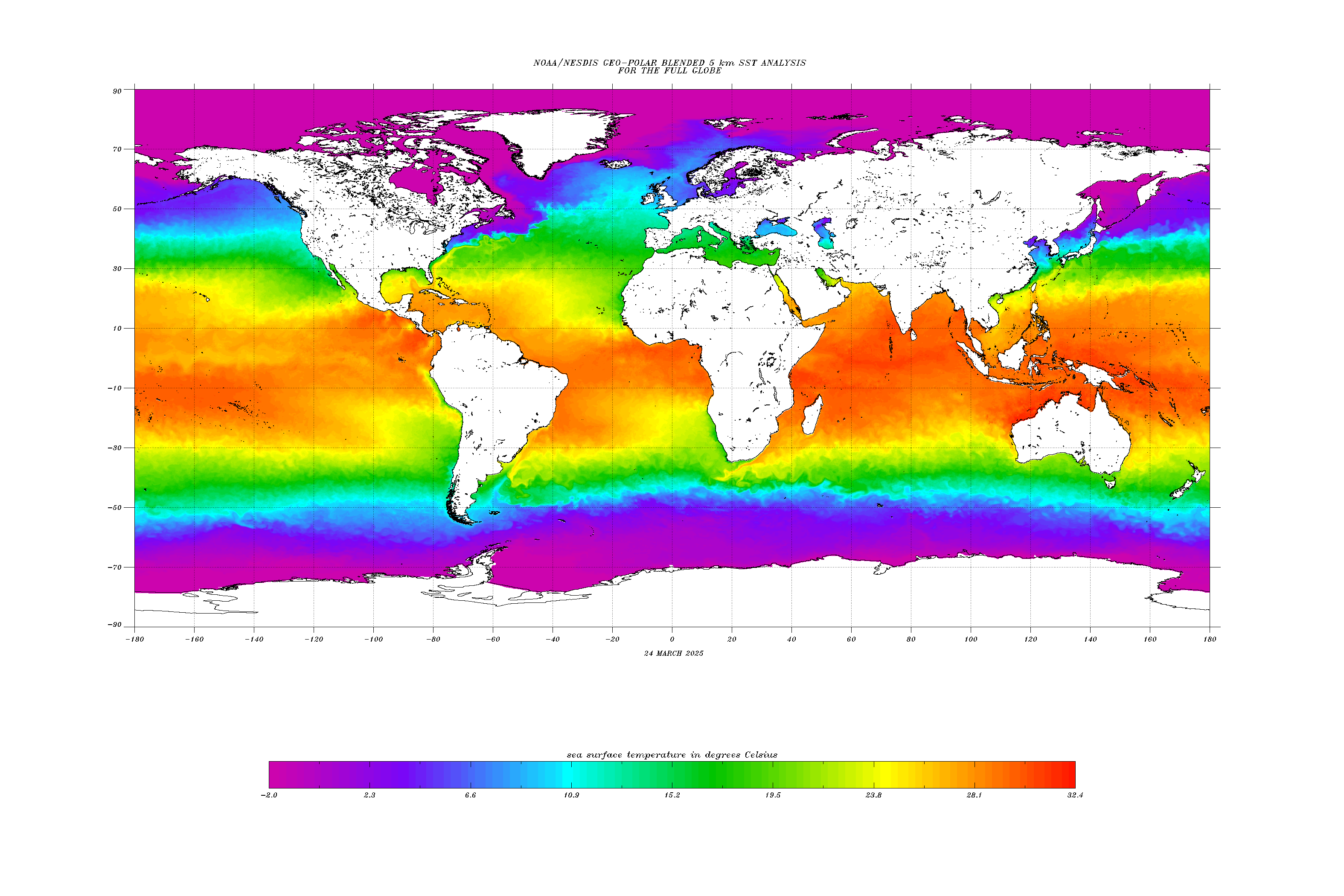
_alternator_
What do you mean by 'very likely to be wrong' and 'not understood' (no scarecaps pls)? There are uncertainties, and there are still unanswered scientific questions, but the measured change in temperatures largely corresponds to the midrange predictions from climate models 20 years ago.
Don't mistake "I don't understand the science" for "the science behind climate change is weak". Go out, learn some coupled atmospheric modeling PDEs, and build a climate model yourself (Claude can help). It'll only take a few days. You'll learn a lot about what's known and the sources of uncertainty.
metalman
Ha! climate models are updated to account for what they get wrong, but off course there are so many thousands of "runs" published that there is "proof" that they got it right the first time. The uncertainty factor surounds the rate of ocean water expansion due to warming ,and resultant sea level rise,coupled with destabising ice sheets, glacial outflows, and other effects on perma frost, natural releae of CO², methane, and calthrates, and quite literaly 50~100 other drivers of atmospheric changes, albedo , rock weathering,cloud density, water vapour, bla baa, fucking blaaa!, on and on it goes been watching and reading since my mom taught me to read @ 3yr's old and nobodys model has reliable data for everything, just factoring in the effects of small waves in the southern ocean will SWAMP, ha!, is totaly beyond claude or even the very best teams, so guesses at best, HUGE unknowns that represent energy exchanges that introduce uncertainties rendering the outputs essentialy useless.
I recently finished rewatching The Three Body Problem in which (spoilers follow) the world panics and goes into overdrive because an alien invasion is due in... 400 years. If the current climate trends continue, vast areas of the Earth may not be suitable for habitation within half that time, and we still can't seem to convince some people this is real. Granted I was a climate change skeptic myself until about 10 years ago, but right now the data seems indisputable. Even if we can't find a direct causal relationship between CO2 emissions and warming, we know the following very accurately (disclaimer: not a climate scientist): (1) amount of carbon dioxide emitted into the atmosphere per year (2) concentration of carbon dioxide in the atmosphere (3) amount of extra energy that would be theoretically retained in the atmosphere via the green house effect, due to a given increment in CO2 concentration, (4) global temperatures within the past, say 30 years. Don't we know for a fact that (1) + (2) + (3) is very well correlated with (4), and that no other potential causes correlate as well with (4), and don't current computational models demonstrate an ability to predict (4) given (3). So, exactly what is the source of skepticism?