The Teaser Period: Why the AI Boom Is Hitting a Reset Wall
Comments
alexpotato
awongh
I get the structural comparison they are trying to make.
But mortgages are not a frontier AI lab.
They try to draw a comparison to the valuation of the real estate and the valuation of the hyper scalers in the markets.
I would argue that the demand and valuation of a house is less elastic than AI. While a house’s value may continue to appreciate in the market there is an upper bound for the price of a house set by people’s income. We don’t know yet what the value of AI is. The underlying product, the model keeps improving and therefore increases its value. A house is still fundamentally a house a year later and doesn’t intrinsically appreciate in value.
From gpt-3 to gpt-5.5 there’s been a massive change in the underlying value of the product and company in a way that simply doesn’t happen with a house. That’s where the analogy breaks down.
whack
Funny how you're echoing exactly what the author said in the article
> This is not precisely 2008. GPUs are not houses; take-or-pay contracts are not mortgage-backed securities; OpenAI is not a subprime borrower in Stockton, and artificial intelligence may well be the most consequential technology of the century, which is more than anyone could ever say for a McMansion in the Inland Empire.
> The bear case in this piece is not that artificial intelligence will fail, or that the demand is fake, or that the technology disappoints. It is narrower: that the financing structure can break before the demand arrives, because the obligations are fixed and front-loaded in commencement while the revenue is variable and back-loaded in adoption - and a fixed obligation meeting a lagging revenue stream is a solvency problem regardless of how transformative the underlying technology turns out to be.
> The industry will spend the next eighteen months debating whether artificial intelligence is a bubble, which is the wrong question, asked at the wrong layer. The technology is real; so were the houses. The question is narrower: what happens when instruments underwritten at the teaser meet their reset schedule, and who is holding the paper when the obligations cannot be met as written
Ie, if you spent $10M buying a house, it doesn't matter if it will be worth $100M in the future. If you're unable to make your mortgage payments in the interim, you're going to lose everything
jumanji493
thanks this is a helpful way of summarizing it
compiler-guy
"The underlying product, the model keeps improving and therefore increases its value."
That's not exactly true. Yes, the fundamental capabilities of the models do seem to be growing dramatically, but the economic value of any particular model may be steady, or even falling, because of commoditization, or other issues external to the model itself.
Without a moat, improvement in model capability does not necessarily translate into economic value--and the labs need economic value to pay their obligations.
PaulHoule
The economic value may be real but the profits may not be.
One thing that's clear is that there is no leading vendor in this space and there may never be one. To some extent premium models can charge a premium price but it's going to be a competitive market and the likes of Anthropic and OpenAI will not be able to sustain monopoly pricing.
josh-sematic
100%. I have sometimes wondered if China is playing the long game with the open weight models trying to tank the margins of the US labs so these profits don’t materialize and the US economy (currently predicated on the net that they will) suffers. I think this is a coherent strategy beyond just “don’t let the US control AI as a strategic asset.”
rkangel
It's the domestic policy version of "commoditise your complement".
slg
The AI debate has often been flattened into "Do you believe in the long term viability of the tech?" when there is also another question that needs to be asked in "Do you believe in the long term viability of these companies' business models?" It's a lot easier to believe the former than the latter.
It's entirely possible for this tech to be humanity altering in the long term while we are also in a huge bubble that could pop at any moment. In that way the housing analogy is apt. The utility of the houses themselves didn't change, the problem was purely with financial markets until eventually those markets made it everyone's problem.
user43928
As of now the compute is fully utilized, progress is rapid, and both OpenAI's and Anthropic's revenue is growing fast.
This could change, but there is no sign of it yet.
No one knows whether other companies are going to catch up, with what compute, or if OpenAI or Anthropic will be able to conquer robotics or medicine.
gedy
Yes exactly the same as during the Dot com bubble.
Supermancho
Having lived to adulthood before Amazon started, I remember the massive debt to profit ratio of many dotcom companies.
Most importantly, I stick to Amazon's lesson: Sometimes, it's not about who's first. The winner can be determined by who's left.
PaulHoule
Notably a lot of those companies went down, a lot of investors lost money, but the internet and e-commerce proved to be just as big as people expected back then, maybe even bigger.
gedy
Yes I that was in reply to OP making similar point about AI
oliculipolicula
Almost, but not quite.
Consider
https://www.ft.com/content/6f3ada65-c56c-499c-8eb6-008fac589...
I hate to say it, but the reality (AI, today) might be closest to PG's "intuition",to wit, it doesn't pay to be left of center-right
For "previous bubbles", I have a different, apolitical,take
olalonde
That is much less of a systemic issue though. It could kill OpenAI or Anthropic, but it wouldn't render these large GPU data centers obsolete since whatever replaces them, be it open models or cheaper closed models, would probably still require a lot of GPU compute.
hakfoo
"probably still requires a lot of GPU compute" is something that would be very desirable to undercut.
There's a galaxy of potential AI markets that are local-only for compliance/privacy/deployment environment reasons, and an equally large and overlapping set of use cases where you won't be able to bolt a rack of thousand-watt GPUs on the side of the device.
What if the next "DeepSeek shock" is something we can run for non-toy use cases on our box of old Android phones? The GPU data centres could be expensive albatrosses very quickly.
There's probably a case that right now, the bigger-is-better paradigm protects incumbents-- a smaller model will always have a FOMO factor unless it can be proven competitive, so that leaves the playing field to those who can afford to train and deploy a new Fable or Sol every few months.
josh-sematic
Less bad, yes. But still bad. There will definitely be demand for the compute, the question is whether it will be enough to keep the value of it at the levels you’d expect if the tenants were in a monopoly/duopoly world. Competition puts downward pressure on margins and that’d translate into pressure on data center leases.
jcgl
Could put pressure on data center margins, but not revenue, and not necessarily gross profit.
ludicrousdispla
As the model keeps improving, to the extent it has some utility, it will decrease in value.
vmg12
The dynamics are interesting. If all businesses get productivity increases from AI, the margins they could have claimed are competed away. The model companies also have their margins competed away because of open models. The only companies that have a moat are the ones with capital as a barrier to entry and even then there is cut throat competition.
We might end up with massive consumer surplus from AI because no business will be able to raise prices due to competition. This is why it's so important that we don't allow for regulatory capture in this space.
plasticchris
Yes and much like the technological leaps of the past, everyone’s standard of living goes up.
Octoth0rpe
> The underlying product, the model keeps improving and therefore increases its value.
I think this is true, but a customer's willingness to spend is based on _perceieved_ value, not actual value. For many companies, the _perceived_ value of AI has been trending down as internal projects fail and cost skyrocket, even as models on paper improve.
jonwinstanley
And the Open Weight models keep improving.
For many tasks, you don’t need a frontier model.
rootusrootus
The value is going up, but the pricing is going down, right? At least at the token level. So the usage would have to go up dramatically to compensate for that.
> there is an upper bound for the price of a house set by people’s income
Isn't that essentially true here too? The money to pay these expected future AI prices is coming from someone's income. Sure, the pie will be growing at the same time, but enough?
chermi
Individuals and families buy houses(ideally). Entities like corporations buy work, often intelligent work. If they can crank up outputs and profits via more intelligent work done by models, I think the ceiling is global demand for the entity's product. Which is still a bound, and ultimately set by individual consumers.
The question is whether the consumers will have the income to spend. So I kind of agree in the end I guess.
rkangel
The performance of the recent open weight models is making it harder for the bug players to justify their pricing.
dimitri-vs
I mostly agree but at the same time the change in underlying value from opus4.6 to Fable has not been as dramatic, and I'm not really sure if a "better Fable" is something most people even need. To the point where a faster and more cost effective model is preferable
Many would argue that opus5 is a regression in value despite what benchmarks say.
pseudosavant
1. The massive amounts of GPUs being purchased have far shorter valuable lifespans than a house.
2. A model's value seems to be depreciating at an unbelievable rate. The most expensive top SOTA models (GPT-5, Opus 4.1) a year ago are far less capable than GPT-5.6 Luna. Compared to when those models were new, Luna costs 85% less than GPT-5 and 98% less than Opus 4.1. That's good for us consumers, but if a lab stumbles for 6-12 months, a lot of their value goes away. Especially with open models only months behind the SOTA closed models.
XenophileJKO
I feel like the idea that GPUs wear out in 3 years is as far as I can tell, generally unfounded.
The GPU build out will keep pumping tokens until the cost to replace is less that the cost to maintain. It is effectively sunk cost.
pseudosavant
Even if it is 5 or 7 years, houses last decades. Even cars last longer than GPUs. GPUs are a highly depreciating asset. They'll last longer than 3 years, but might not be very cost effective (tokens per Wh) compared to the latest AI accelerators that are available.
I wonder if it will be that the U.S. (and allied countries) will be using the latest 1-2 generations of AI accelerators, and if the 3-5+ year old stuff will be sold to Chinese datacenters since that will still be the most powerful tech we'll be allowed to export to them?
doug_durham
I'm still paying OpenAI $20/month for a product that has gotten massively more valuable. That's the problem. They aren't getting any more money from me for a product which is much more valuable.
krona
GPUs depreciate at a far, far faster rate than houses do. And then they need to be replaced. Who's paying for that? OpenAI and Anthropic don't even have positive free cash flow.
tyromaniac
I think its well corrected by the increase in competition that meets or exceeds the quality. The house may have gotten nicer but now you are selling a single room
dominotw
> We don’t know yet what the value of AI is. The underlying product, the model keeps improving and therefore increases its value.
i dont know. i think we already know how far these things go. Buying tons of data on mercor to slightly improve one domain has not really even displaced ppl in that domain. i really cant tell the difference between opus 4.8 and 5
very few domains in the world are closed like math.
analognoise
You pointed out correctly that house prices are bounded by incomes, then immediately made the same mistake with AI - someone has to want to pay for this stuff. It also has to compete against free models, which are not only almost as good, but they pull ahead sometimes.
Saying “the product increased in value” is only true if someone buys it!
Espressosaurus
Interesting piece, I just wish the author had presented the data and their thesis instead of making Claude vomit out 20 pages of trash around it.
johnfn
I really want to get in the mindset of people who are like "AI is totally going to fail! Haha! Now let me just use AI to write a piece about it..."
Espressosaurus
It's not inconsistent if you think of it as the finances falling apart regardless of how useful the tool is.
johnfn
The article claims that the finances fall apart because OpenAI won't hit the growth it wants. It's an interesting thing to say when using their product to write 100% of the article.
owebmaster
Using the free version reinforces the point.
throwawayqqq11
Bubble != AI.
lightbulbish
What exactly do you/others feel read AI about it? I spend an inordinate amount of time with AI and this did trigger my ai-radar, something I’m otherwise very sensitive too. I’m genuinely curious what phrases/words people reacted to!
Sharlin
Yeah, the signal-to-noise ratio was way too low to keep reading for long.
olalonde
I strongly recommend summarizing the article with Claude.
doug_durham
Really? Did you read the article? I did. It read as quirky human to me.
Espressosaurus
You need to adjust your AI detector. I read the whole thing and it reads exactly like all the Claude reports I spend all day reading when I’m using it to write code or investigate something.
jere
[dead]
nnevatie
Indeed - obvious AI slop with the annoying language all of the place.
jumanji493
wow excellent piece. Gary Marcus had a long post about this article on his substack.
scary stuff
"And look at what this implies about OpenAI’s valuation as it moves toward an IPO:
OpenAI’s equity - valued north of $850 billion - is functionally the junior tranche of a capital structure whose senior claims, the take-or-pay compute obligations, exceed any revenue path management itself has articulated.
On those numbers, the equity is effectively underwater, and the market has not priced it that way because it still treats those obligations as service agreements rather than what they are economically: debt.
Even if OpenAI can meet those obligations, OpenAI’s unaudited financial statements - as of March 31, 2026 - disclose $665 billion in non-cancellable compute commitments (management’s more recent plan runs to $750 billion). These commitments are take-or-pay in structure - which, as established above, is debt.
Carry the net present value of those obligations as senior debt - roughly $450–500 billion, the same methodology rating agencies have used for decades to capitalize take-or-pay contracts as debt - and a company the market prices as debt-free carries a senior claim worth more than half its entire equity value."
and the 2008 analog
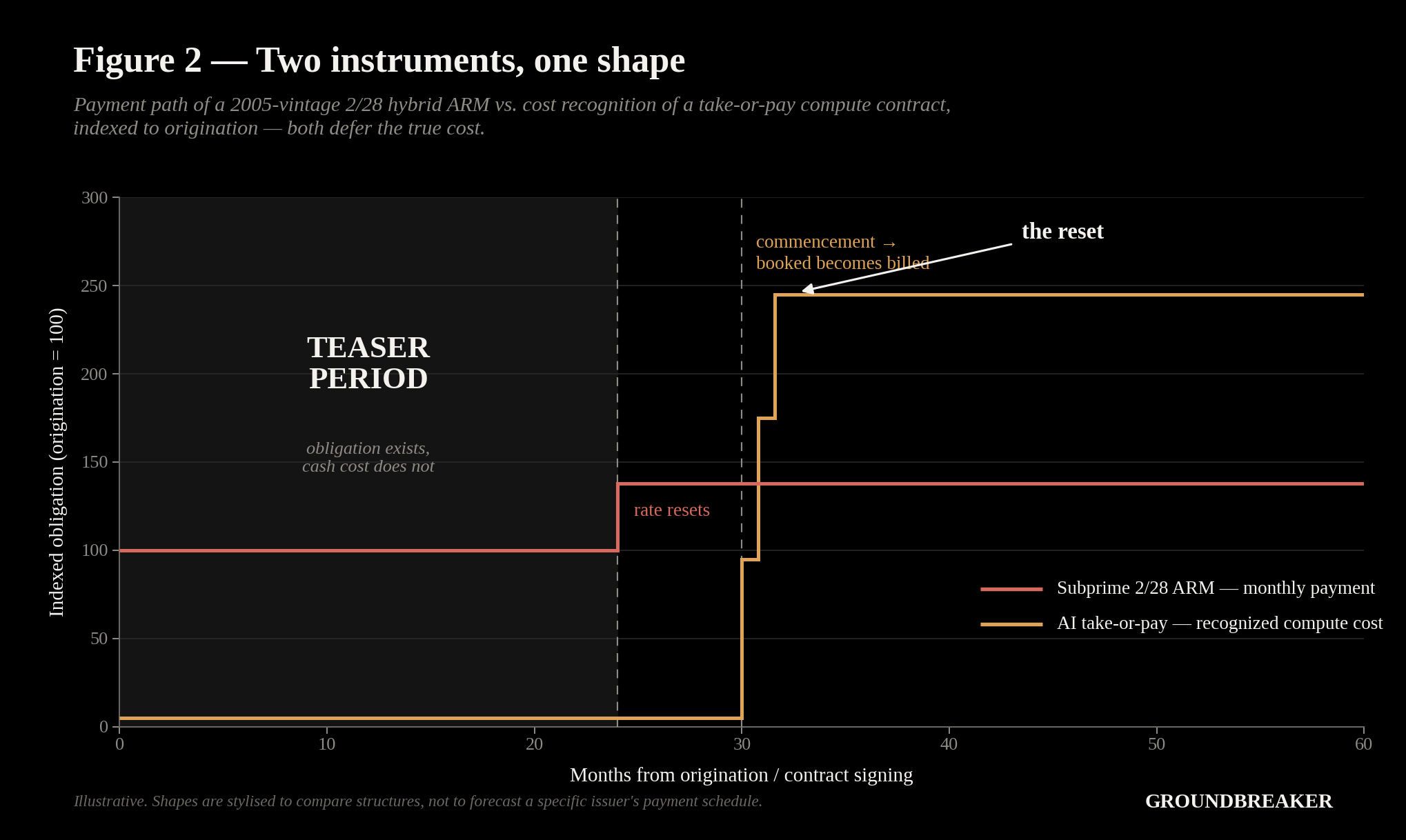
"Millions of subprime borrowers were, at that moment, paying the low introductory rate on a two-year adjustable rate mortgage - the 2/28 ARM. A low fixed-rate for two years, then the rate reset to a payment 30% to 50% higher. During those first two years the loan performed beautifully: the borrower paid, the servicer collected, and the bond paid its coupon. Nothing looked wrong because the whole complex - housing, mortgages, securitization - was sitting inside the teaser period.
The AI boom has rebuilt this exact structure, and the market is once again underwriting the teaser.
It has a reset wall of its own - a schedule of dated, contractual, non-negotiable payment shocks - hiding inside the trillions of dollars of compute contracts signed by OpenAI and other frontier labs since 2024."
ameliaquining
Marcus believes that the underlying technology doesn't work. If that's true, then of course the whole thing will crash as soon as everyone realizes this.
This article is mostly making a different argument (though it contradicts itself in some places), which is that even if the underlying technology does work, and is ultimately going to create quadrillions of dollars of value and transform society, if it takes more than another 1–2 years for that to happen, then there'll still be a crash, because that's when the data center construction bills come due and the labs (especially OpenAI) don't yet have the money to pay them.
It argues primarily against a hypothetical optimist who believes that everything is fine because the cash flow numbers currently work out, on the grounds that this hypothetical optimist hasn't realized that the labs' recurring expenses are scheduled to spike in 1–2 years when the data centers come online and the labs have to start paying for them. It also spends a lot of words comparing the situation to the 2008 financial crisis, because that's everyone's favorite morality tale.
I am not sure that anyone is actually making this mistake (i.e., trying to predict the future by looking at labs' present cash flows). The better counterargument is what Matt Levine used to call "Netflix Theory": if the large capital investors who own stakes in the labs still believe in their valuations (which they should, if the technology works and the quadrillions are coming, which we're assuming here for the sake of argument), then they will be very highly motivated not to let their investment be seized by the labs' creditors. So the labs will not have too much difficulty raising or borrowing enough money to pay the bills.
michaelchisari
There's a third possibility between works and doesn't work:
Works but not quite good enough to make the case against commoditization.
If open source or on-device AI gets good enough for 80% of consumers, then this stops being a consumer product and the only real market is people who need the high-end models. If those models are slow and expensive, certain tasks like scientific and math research can tolerate slowness, but they run up against the costs. If they're expensive, the tech industry can afford them but runs up against their inefficiencies.
We need to talk about how well these improving models work in multiple dimensions: Accuracy, performance and cost. All three have to improve considerably before the debate dies down.
ameliaquining
Yes, if the tech works but in a way that doesn't let the labs command premium prices for inference, then that also means a crash. But that's a fundamentals-based argument like Marcus's (despite being based in economics rather than ML science), so distinct from the one the article's mostly making.
w10-1
> large capital investors [...] will be very highly motivated not to let their investment be seized [...] So the labs will not have too much difficulty raising or borrowing enough money to pay the bills
So: sunk costs of large investors mean they'd be willing to pay high interest costs? Thus small investors can rely on this dynamic, shielded by big ones?
Remember, the large investors got large in a near-zero interest rate environment (where exact timing doesn't matter as much), but those days are not coming back. Soon margins will matter most, and while NVDA and Apple have the internal discipline for that, OpenAI et al do not.
dumberquestions
Yes, the labs will be fine as long as investors believe in them, and they overwhelmingly do, trying to draw comparisons based on traditional market wisdom will fail because none of this is precedented.
alwa
This feels like Claude thought to me—assertions and comparisons that look impressive on the surface, but kind of make me scratch my head the more I think about them.
I think what made me throw in the towel was “Figure 2 — Two Instruments, One Shape” [0]. That chart comparing when contracts reset. Weirdly consistent norms! [looks at the sourcing] Oh… it’s… not from data at all… it’s just notional…
Is there anything here other than “the people financing the factory are betting that it’ll be able to sell what it makes once it’s built”?
I mean… isn’t “an instrument that splits time in two” kind of… what capital financing is? And this risk is what earns investors their interest, and the rest of the financial system involves different ways for people to calibrate their bets on the risk materializing?
Including derivative instruments that allow investors to smear out the point-in-time “cliffs” this writer is concerned about? If you think the revenue is never going to come, you can bet on that now. Or go into the distressed datacenter acquisition business to prepare! Conversely if Payment Day comes and you think they just need a couple more months, you can adjust the loan or make them a new loan to cover those first few months’ payments, etc., right? Since both parties stand to lose if it blows up completely, unless it’d be worth more to sell to somebody else?
These are also not individual homeowners’ “investments.” The risk is coordinated, and it’s big, but we know that already, right? Yes we know the revenue, yes it’s different from the costs of paying down their capital investments, yes both are reported on the financial disclosures.
How is the claim here any stronger than “all this depends on them actually being able to sell this crap once they get it built”?
[0] https://substackcdn.com/image/fetch/$s_!-2DS!,f_auto,q_auto:...
hungryhobbit
Yeah it's funny: I'm pretty sure (based on what he writes about) that the author didn't use AI to write it.
Still ... he's more verbose than Claude itself .. and Claude is very, very verbose!
yoggies_bro
Became obvious it was AI authored as I read, classic AI overstatement of parallels, lots of jargony words, its not X it is Y.
mizzao
If someone takes a bunch of good ideas and turns them into an essay with the help of AI, does that make the ideas inherently untrue?
qoez
I always imagined they're doing that psychological experiment where they randomly give a rat food when they press a button. They get way more addicted than when it's a consistent amount. They can't get away with the optics of facebook-level gamification but this is some sort of loop hole.
Havoc
It’s an interesting comparison. The housing market is linked to the value of the house though which is subject to crashes in value without a corresponding drop in demand.
With AI it comes down to whether the large companies orders and building of datacenters aligns with token demand. There is years worth of lag there so they kinda have to front load this by necessity
Synaesthesia
IMO there is overinvestment in compute and this will turn out to be a bubble.
But all of the money was anyway just lying around doing nothing. An enormous amount of capital has been building since the 80's thanks to corporate profits. A small sector of the population is so rich they don't know what to do with their capital.
NDlurker
So, start selling risky assets for bonds and wait for the crash to buy back in to stocks?
CBLT
If you can actually time the market, sure. I cannot, so I don't pull money out of my stock indexes; I just send a larger fraction of my new investments into bonds.
NDlurker
That's a smarter idea. I've tried timing the market in the past and have been very wrong.
lesuorac
Who are you going to sell the bonds to?
People only want cash during the crash so the value of everything goes down. It doesn't matter if you bond has a known 8% yield when held to maturity; the market can't hold it to maturity so its current value drops.
Like go find 2008 in the graph of BND (Vanguard Bond ETF) vs SPY (SNP500) [1]. Let me know how you'd know when to sell your bonds for stocks.
[1]: https://www.google.com/finance/beta/quote/SPY:NYSEARCA?keymo...
bradfa
It would be nice if the article cited the actual contracts the labs have signed so that others could also read them and draw their own conclusions (maybe it does and I got tired of the slop-like writing style too early?).
Are the contracts actually take-or-pay-style? What are the terms? What are the amounts of compute and money involved for each future time period? What happens if the datacenter costs spiral upwards? What happens to the datacenter investment if the buyer goes bankrupt, goes public, or gets acquired (potentially by the datacenter owner)?
I personally think the datacenter build-outs are going to generally be a big swing and a miss. The problem 1-2 years ago was making models good enough to be useful for a variety of tasks. Now we have that. The next problem is making the models efficient enough to run a profitable business. Recent Chinese lab model releases (because they're already constrained on compute resources) and OpenAI price cuts on Luna seem to indicate that this transition to chasing efficiency has already started.
krona
> The next problem is making the models efficient enough to run a profitable business.
In that world, what does Oracle do with a bunch of data centres which 1. It needs to pay for and 2. nobody needs. This is what the article is about: building supply far in advance of demand.
bradfa
I don't know, but unless that contract is public, not many people know. I get the impression Oracle got a little bit of market pushback on the risk, as theirs seems to be one of the largest.
krona
What contract? It's mostly corporate debt. Seems pretty plain and simple to me.
The contracts I guess you're talking about are compute obligations which frontier labs have. I don't need to know what those obligations are to know what happens to Oracle.
tschellenbach
This post is just AI slop. The details of these contracts aren't disclosed as far as I know.
You need to understand the contracts, the acceleration of demand, how the various inputs into supply scale (energy, chips, data centers) etc to say something sensible about this.
harshaw
Some other commentators said this was AI slop. I don't have enough expertise to say if it really is, but it sure has the "claudish" cadence of AI generated text that makes it hard to take it seriously. The authoritative and strong statements, the use of phrasing with colons and dashes, the use of bold, etc.
ameliaquining
Pangram confirms: https://www.pangram.com/history/9ccdf6ed-5016-4325-b1ac-b3b0...
I find it amusing that even the AI skeptic articles are written with AI these days.
Espressosaurus
The claims and data are interesting (perhaps overstated in the usual Claude way) but it's about 20x more prose than is actually justified.
georgemcbay
> Some other commentators said this was AI slop.
To me it read like a combination of human written and AI slop, as if the author had Claude write it and then rewrote portions of it, or the author wrote an initial version and told Claude to "punch it up, without rewriting the whole thing entirely".
Regardless of who or what actually wrote it the piece was much longer than it needed to be (though I do think it highlights a very real problem).
aaroninsf
Similar looking charts do not make AI companies into subprime loans.
hughw
"The hidden mechanics reveals how the AI boom breaks, and when."
I stopped there. I just resist reading slop.
spwa4
TLDR: what determines if we'll have an AI crash is whether the Anthropic and OpenAI IPOs provide enough money to cover compute for these companies. Without IPOs, these companies cannot survive 2026 and this will have drastic consequences for the hyperscalers, datacenter companies, energy companies, ... ie. the "AI crash".
Anthropic: $100B, OpenAI: $150B (that's not market cap, that's what they have to raise with the shares they issue in their IPO). If they make this money, the AI crash is delayed, at least to 2029.
To give a point of comparison: SpaceX got about 85B in cash to spend from its IPO.
(This is assuming the datacenters ordered actually get built between now and 2030 or so. If not crash is guaranteed)
firmretention
Sloppity slop.
NDlurker
That was the impression I got too, so I just skimmed it
atleastoptimal
Someone who only knows finance trying to apply that logic to the singularity. There is no comparison. AI does not obey money, money obeys AI, or rather, the operating force of commodified intelligence will not just evaporate when inconvenient obligations for payment come around.
Also it seems evident the article is largely AI written, which makes it even funnier.
> Every ARM reset was known, dated, and contractually inevitable from the moment of origination. Aggregate those reset schedules and you get the most damning exhibit of the era: the reset wall.
One of my distinct memories from this era is watching CNBC where a guest said exactly the same thing.
As the interview went on, he became more animated and used stronger language to the point of:
"You don't get it, THEY ARE GOING TO BE PICKING PEOPLE OFF THE FLOOR when these ARM rates reset"
I would guess this was right about 2006 which lines up with the article.